
How to Take Saffron: Dose, Timing, Safety, and What to Expect
What saffron is and why people take it
Saffron comes from the dried stigmas of Crocus sativus, and most people know it first as a culinary spice. That version is used in cooking for color, aroma, and flavor. Supplement saffron is different. It is usually a standardized extract designed to deliver measured amounts of key compounds such as crocin and safranal.
That distinction matters. If you are looking into saffron for mood support or stress resilience, you are not really asking how to cook with saffron. You are asking how to take a form that matches how saffron has been studied.
The interest is understandable. Saffron has attracted growing attention for its potential to support mood balance, emotional well-being, focus, stress adaptation, and libido. Some readers arrive here because they are curious about saffron benefits for female wellness in midlife. Others are looking into saffron benefits for male libido, motivation, or mood support. In both cases, the appeal is similar: a plant compound with real research behind it, but not a harsh or all-or-nothing intervention.
It is also worth setting the tone early. Saffron is promising. It is not magic. It may help support how you feel over time, especially when taken consistently, but it is not a shortcut around sleep, hormones, relationship stress, or deeper mental health concerns.
What the research on saffron actually suggests
Most clinical research on saffron for mood support has used about 28 to 30 mg per day of standardized extract. Many of those studies run for 6 to 8 weeks, which gives a useful benchmark for what "consistent use" actually means.
The evidence is encouraging, not definitive. Across multiple trials, saffron has shown meaningful mood-supporting effects for some people. At the same time, many studies are small and short in duration. That means the strongest honest takeaway is this: saffron appears worth considering for everyday mood support, but the long-term and large-population data is still developing.
Who this article is really for
This article is for the person dealing with low-grade flatness, mental fog, stress load, or a sense that they do not quite feel like themselves. It is not written for crisis-level symptoms, and saffron should not be framed that way.
Saffron is not a replacement for prescribed medication, therapy, or medical care. If you are dealing with persistent or severe symptoms, or anything that is interfering with daily function, professional support is the right next step.
How to take saffron: the best form, dose, and timing
If you want the clearest answer up front, here it is: the most practical way to take saffron is as a standardized supplement at the clinically studied dose range, usually around 28 to 30 mg per day, taken consistently every day for several weeks.
That is the simplest version. The details matter too.
You can find saffron in a few common forms:
- standardized capsules or tablets
- liquid extracts
- saffron tea or infusions
- culinary saffron threads
For supplement-style use, standardized capsules are usually the easiest to use well. They let you know how much saffron extract you are actually getting. Tea and culinary threads can be enjoyable, but they are much less precise if your goal is measured daily intake.
Just as important, saffron dose per day is better approached through standardized milligrams than through guesses like thread count. Culinary saffron varies too much for that to be reliable.
And no, taking more is not usually better. Consistency matters more than escalation.
What form of saffron is easiest to use consistently?
For most people, standardized capsules are the most reliable option. They are portable, measurable, and simple to build into a daily routine. If a label clearly states the extract amount and standardization markers, you have a much better sense of what you are taking.
Saffron threads and tea can absolutely be part of a healthy routine. They just are not ideal for supplement-style dosing. The amount of active compounds can vary widely, and most people are not weighing culinary saffron precisely enough to mirror clinical use.
If your goal is occasional enjoyment, threads are fine. If your goal is mood support, emotional steadiness, or stress resilience over time, a standardized extract is usually the better fit.
How much saffron should you take per day?
Most clinical research on saffron for mood support uses about 28 to 30 mg per day of standardized extract. That is the range with the strongest practical backing.
Higher doses are not automatically more effective. In fact, pushing the dose higher may simply increase the chance of side effects without improving the outcome. More is not more here. The smarter approach is to stay close to the studied range and give it enough time to work.
If a product does not clearly tell you the amount of saffron extract per serving, or avoids standardization details altogether, that is a reason to pause.
Based on your article flow, this table should sit after the section **When should you take saffron: morning, evening, or with food?** ```html| Timing | How to take saffron | Best for |
|---|---|---|
| Morning | Take your daily saffron serving with breakfast, coffee, or your regular morning supplement routine. | People who want the easiest routine and prefer taking supplements earlier in the day. |
| With food | Take saffron alongside a meal or snack if supplements sometimes feel harsh on your stomach. | People with a sensitive stomach, mild nausea from supplements, or inconsistent tolerance when taken alone. |
| Split dosing | If the formula uses two capsules per day, take one in the morning and one later in the day. | People who prefer spreading their supplement routine out instead of taking everything at once. |
| Evening | Take saffron later in the day if that is the time you will remember most consistently. | People whose supplement routine is already built around dinner or evening habits. |
| Earlier in the day | Choose morning or midday if your saffron formula also includes more energizing ingredients such as Rhodiola. | People using a broader mood, vitality, or stress-support formula rather than saffron alone. |
When should you take saffron: morning, evening, or with food?
For most people, the best time to take saffron is the time they will remember to take it every day.
Morning often works well because it is easy to attach to an existing habit like breakfast, coffee, or a morning supplement routine. If a formula uses two capsules per day, some people take both in the morning, while others prefer split dosing across morning and evening.
Saffron is generally well tolerated with or without food, but taking it with food may feel gentler if you have a sensitive stomach.
Timing usually matters less than consistency, unless the full formula includes ingredients that feel more energizing. For example, a saffron formula that also contains Rhodiola may fit better earlier in the day for some people.
What results to expect and how long saffron takes to work
This is where realistic expectations matter most.
Saffron is not something most people feel overnight. In clinical research, changes are usually measured over 4 to 8 weeks of daily use. That does not mean nobody notices anything sooner, but it does mean you should not judge it after three inconsistent days.
What people may notice first tends to be subtle. Less emotional flatness. A little more steadiness under stress. Slightly clearer thinking. In some cases, a return of interest in intimacy or a little more sense of spark.
That said, response varies. Some people feel a clear difference. Some notice only a mild shift. Some notice little or nothing at all. That is true of supplements, and honestly true of many health interventions more broadly.
Signs saffron may be helping
Early signs tend to be small rather than dramatic. You may feel:
- less reactive to everyday stress
- a bit more emotionally even
- slightly more motivated
- clearer in your thinking
- less foggy or mentally dull
- a little more interested in closeness or intimacy
Those are possible signs of support, not guaranteed outcomes. Saffron tends to work, when it works, by gradually shifting the baseline rather than producing a sharp before-and-after effect.
What saffron cannot do
Saffron cannot treat depression, anxiety disorders, ADHD, menopause, insomnia, or sexual dysfunction. It is a dietary supplement, not a treatment for diagnosable conditions.
It also cannot override chronic sleep deprivation, major relationship stress, untreated hormonal issues, nutrient deficiencies, or deeper mental health concerns. If the root issue sits elsewhere, saffron may be supportive, but it will not solve the whole picture by itself.
Safety, side effects, and who should be careful with saffron
Saffron appears to be well tolerated for many people when used in studied amounts, but it is still a biologically active supplement. It is not accurate to say it has no side effects or suits everyone equally.
Possible mild side effects can include:
- digestive upset
- headache
- dizziness
- nausea
- individual sensitivity
If you are taking prescription medication for mood, sleep, blood pressure, or any ongoing condition, talk with your healthcare provider before adding saffron. The same applies if you are pregnant or nursing. This article is for informational purposes and is not medical advice.
Can you take saffron every day?
Yes, daily use is how saffron is typically studied. Most of the research uses consistent daily intake rather than occasional use, and there is no established routine cycling protocol in the literature.
That said, whether daily use makes sense long term should still be considered in the context of your overall health, medication use, and why you are taking it in the first place.
Possible interactions and higher-risk situations
Extra caution makes sense if you are combining saffron with antidepressants or other prescription medications. That does not automatically mean it is unsafe, but it does mean clinician guidance matters.
The same caution applies if you are pregnant, nursing, preparing for surgery, or managing a more complex medical picture. In those situations, do not guess.
How to choose a saffron supplement that is worth taking
The saffron category is crowded now, which makes label reading more important than brand promises.
A useful starting point is to look for:
- standardized saffron extract
- a clinically aligned daily dose, usually around 28 to 30 mg
- third-party testing
- transparent labeling
- a clear explanation of any added ingredients
Some supplements are saffron only. Others are built as broader formulas that try to support stress resilience, nervous-system function, or the gut-brain axis alongside saffron itself. Neither approach is automatically better. It depends on what you are trying to support.
What to check on the label before you buy
Before buying, check:
- the dose per serving
- whether the extract is standardized
- how many capsules make up a serving
- whether the bottle gives a full 30-day supply
- whether the brand explains why additional ingredients are included
Be cautious with vague "proprietary blends" or saffron products that never disclose standardization or meaningful amounts. If the label is unclear, the formula probably is too.
When a complete saffron formula may make more sense
Some people do well with saffron alone. Others want more support built in, especially if stress load, low resilience, brain fog, or gut-brain concerns are part of the picture.
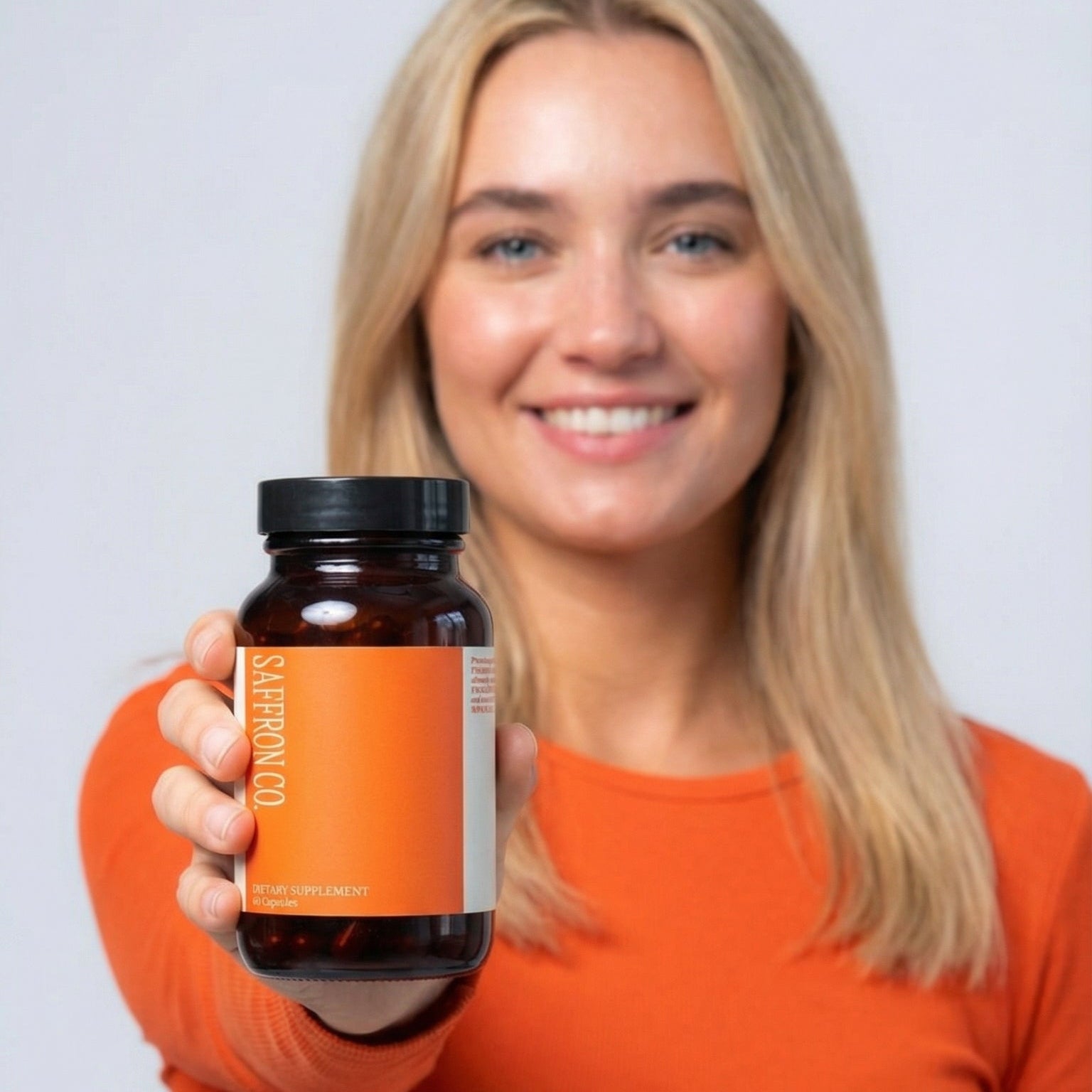
That is where a more complete formula can make sense. Saffron Co Mood and Vitality Capsules are designed for that use case. The formula centers on 30 mg per day of clinical-grade Spanish saffron extract, standardized to ≥3.0% trans-crocin and ~1.2% safranal, then adds Rhodiola rosea for stress adaptation, magnesium glycinate for nervous-system support, active vitamin B6 for neurotransmitter activation, and a probiotic to support the gut-brain axis. If you want to understand the formulation logic in more detail, the why this formula page is the best place to start.
The honest caveat is that Saffron Co is a newer brand, so it has less long-term independent market history than some more established competitors. The 90-day money-back guarantee is how the brand answers that honestly. It gives you enough time to use the formula consistently and decide based on your own response rather than a rushed first impression.
Buy it if you want a saffron-centered formula that goes beyond saffron alone, you value the supporting ingredient logic, and you prefer the security of a 90-day guarantee. Consider a simpler single-ingredient saffron product instead if you want the most minimal formula possible or already have the surrounding pieces of your supplement routine covered.
FAQ
How do you take saffron for the best results?
The best approach is usually a standardized saffron supplement taken daily at the clinically studied dose range, most often around 28 to 30 mg per day. Take it consistently for at least several weeks rather than expecting a fast effect.
What is the right saffron dose per day?
Most clinical research on mood support uses about 28 to 30 mg per day of standardized saffron extract. That is the most evidence-aligned place to start. Higher doses are not automatically better.
Should I take saffron in the morning or at night?
Either can work, but morning is often easiest for consistency. If your formula includes two capsules, you may take both in the morning or split them. Taking saffron with food may feel gentler if you have a sensitive stomach.
How long does saffron take to work?
Most studies look at outcomes over 4 to 8 weeks of daily use. Some people may notice subtle changes sooner, but saffron is generally not an overnight supplement.
Can I take saffron every day?
Yes. Daily use is how saffron is typically studied, and there is no routine cycling protocol established in the research. Long-term use should still be considered alongside your overall health and any medications.
Can saffron be taken with antidepressants or other medications?
Do not assume so without guidance. If you take antidepressants or any prescription medication, talk with your healthcare provider before adding saffron. The same caution applies during pregnancy, nursing, or when managing ongoing medical conditions.