
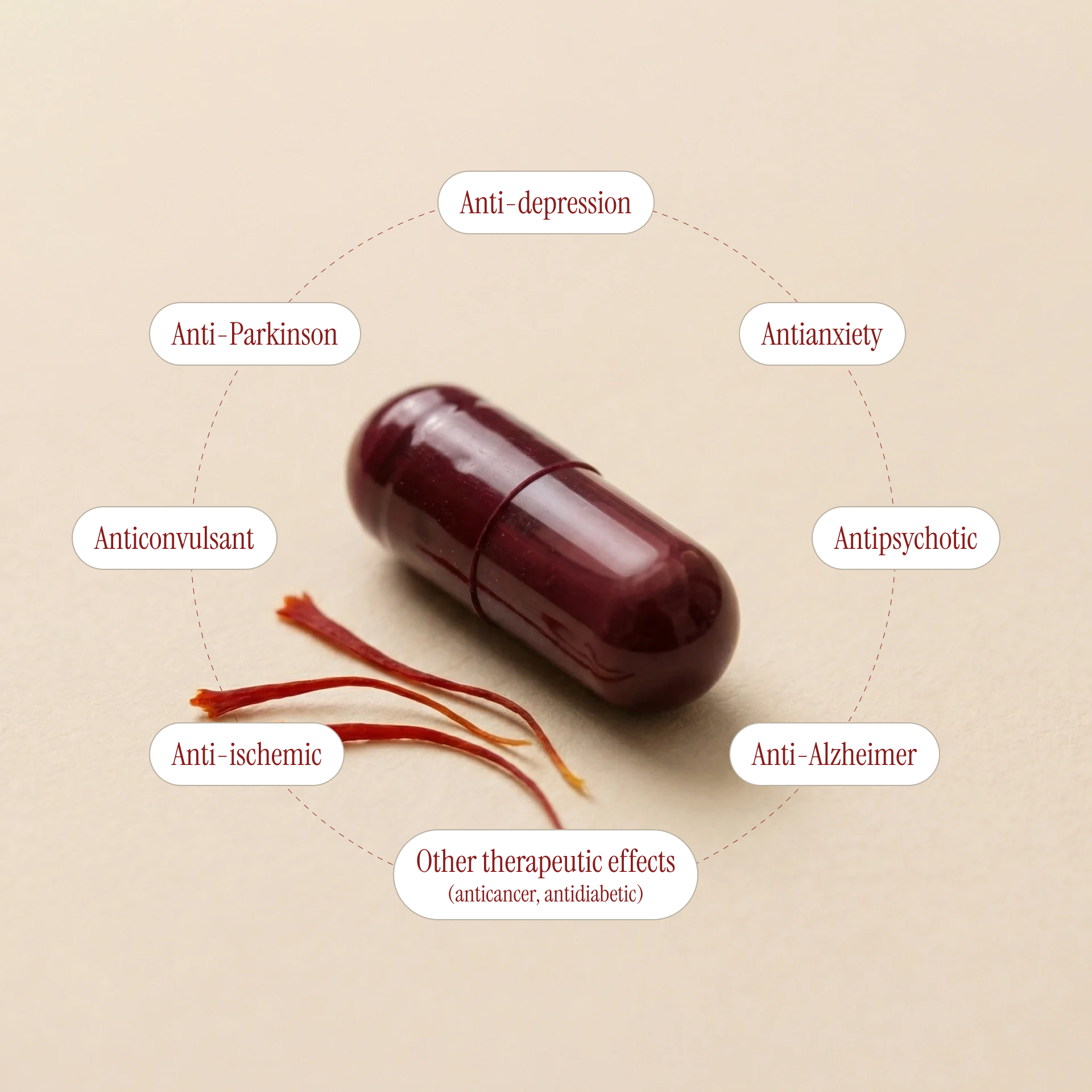
Saffron Extract: Benefits, Dosage, Side Effects & What the Research Says
What Is Saffron Extract and Why Are So Many People Interested in It?
Saffron extract is a concentrated supplement form of Crocus sativus, the same plant that gives us saffron spice. But in practice, saffron extract and the saffron threads used in cooking are not the same thing.
That distinction matters.
When people search for saffron extract, they are usually not looking for a paella ingredient. They are looking for a supplement that may help support mood balance, emotional well-being, stress resilience, focus, libido, or a general sense of feeling more like themselves again.
That interest is not coming out of nowhere. Saffron has been clinically studied, especially in the mood-support category, and much of that research centers on standardized extracts in the 28 to 30 mg daily range. But not every product on the market reflects that research well. Some are underdosed. Some do not disclose meaningful standardization markers. Some rely on vague claims instead of formulation quality.
A saffron supplement is only as credible as its dose, extract quality, testing standards, and label transparency.
Saffron spice vs saffron extract
Culinary saffron comes from the dried red stigmas of the saffron flower. It is prized for flavor, aroma, and color. It is also expensive, which is one reason supplement buyers can easily assume that any saffron product must be premium by default.
Not necessarily.
Saffron extract is made by concentrating compounds from saffron and standardizing the result so the active constituents are more consistent from batch to batch. In supplements, that standardization is the meaningful quality signal. It tells you more than the word "saffron" alone ever could.
Researchers often pay attention to compounds like crocin and safranal, and higher-quality supplements usually disclose those markers. That makes it easier to compare one product with another in a way that cooking saffron simply does not allow.
What makes a saffron supplement worth considering
If you are comparing products, there are a few criteria that matter more than branding language:
- a clinical dose that aligns with the research
- standardization to active compounds such as trans-crocin and safranal
- third-party testing and clean-label quality signals
- a formula that has a clear reason for including any added ingredients
- realistic claims instead of miracle language
Those are the filters that help separate a thoughtful saffron formula from an expensive label.
Saffron Extract Benefits: What It May Help Support
The strongest reason people consider saffron extract is mood support. That is where the best-known clinical research sits, and it is where saffron has earned the most credibility.
That does not mean every claimed benefit is equally established. Some are better supported than others.
If you want a deeper look at the published data, Saffron Co's overview of saffron clinical studies is a useful place to start.
Mood support and emotional balance
This is the area where saffron extract stands on the firmest ground.
Multiple clinical trials have studied saffron extract for mood support, with many using 28 to 30 mg per day over 6 to 8 weeks. The overall picture is encouraging. Saffron appears to help support mood balance and emotional well-being for some people, particularly when taken consistently over time.
That said, the research is not flawless. Many studies are relatively small and short-term. The honest takeaway is not that saffron is a cure. It is that saffron has been clinically studied for mood support, and the results are promising enough to take seriously.
For women who feel flat, emotionally dulled, or less resilient than they used to be, that distinction matters. Saffron may help support the chemistry underneath that experience. It is not a substitute for therapy, medication, or deeper medical evaluation when those are needed.
Stress, focus, and mental clarity
Saffron extract is also commonly used for stress support, focus, and mental clarity.
Here the evidence is more emerging than definitive. Some studies and mechanism research suggest saffron may help support attention, stress response, and cognitive clarity, likely through its effects on neurotransmitters and oxidative stress. But these benefits are not as robustly studied as mood support.
So if someone is primarily looking for help with feeling foggy, overstretched, or mentally scattered, saffron may still be worth considering. Just keep expectations grounded. It is more credible as a mood-support ingredient with possible spillover benefits for clarity and resilience than as a direct cognitive enhancer.
Libido and sexual wellbeing
There is also a relevant research around saffron extract and libido support.
This tends to be especially interesting for women dealing with low desire tied to chronic stress, emotional flatness, or midlife hormonal shifts. The evidence here is not as extensive as it is for mood, but it is enough to make libido one of the more plausible secondary benefit areas for saffron.
Again, moderation matters. Saffron may help support libido for some people. It is not a guaranteed fix for relationship issues, hormonal changes, medication side effects, or deeper sexual health concerns.
Saffron extract for weight loss: what the evidence really suggests
This is one of the most common saffron search terms, so it is worth answering directly.
Saffron extract is not strongest as a weight-loss supplement.
Some research suggests it may help support appetite control or reduce snacking behavior in certain contexts, which could be useful for people whose eating patterns are tied to stress or low mood. But that is not the same thing as dramatic fat loss, and it should not be marketed that way.
If someone is buying saffron extract mainly for weight loss, they are probably using the category for its weakest use case. If they are interested in mood support first and see appetite regulation as a possible side benefit, that is a more realistic frame.
How Saffron Extract Works in the Body
Saffron extract is interesting partly because it does not rely on a single compound. Researchers have identified several active constituents that may help explain its effects.
The compounds researchers pay attention to
The three names you will see most often are crocin, crocetin, and safranal.
Crocin is linked to many of saffron's antioxidant and neurological effects. Crocetin is related and may help with absorption and biological activity. Safranal contributes to aroma, but it is also relevant in research on saffron's neuroactive profile.
In supplement terms, crocin and safranal are often the practical quality markers. A standardized extract gives you a clearer sense of what you are actually taking. Without that, two saffron products can look similar on the front label and be very different in real quality.
Why the 30 mg daily dose comes up so often
The 30 mg daily dose appears so often because that is where much of the clinical research has been done.
This is not just marketing shorthand. It reflects actual trial design.
In many saffron studies, participants took around 28 to 30 mg per day, often for 6 to 8 weeks. That makes this range the most evidence-aligned starting point for people evaluating supplements. It also reminds us that more is not automatically better. With saffron, the goal is not to chase the highest possible dose. It is to use a dose that matches what has actually been studied.
Mechanistically, saffron may help support mood and clarity through several pathways:
- modulation of serotonin, dopamine, and possibly norepinephrine activity
- antioxidant activity that may help protect nerve cells
- possible support for BDNF, a factor involved in neuronal health and plasticity
That science helps explain why saffron comes up so often in conversations about feeling flat, foggy, or emotionally overstretched. It appears to work on systems that influence mood, motivation, and stress response rather than acting like a stimulant or sedative.
How to Take Saffron Extract Safely: Dosage, Timing, and Side Effects
For most readers, the practical questions matter most. How much do you take, when do you take it, and what should you watch for?
Typical dosage and how long it may take to work
The most common clinical range is 28 to 30 mg per day.
That is the range used in many of the best-known saffron studies, especially for mood support. Some products split the daily dose into two capsules. Others provide it once daily. There does not seem to be one universally required timing protocol, though many people prefer taking saffron earlier in the day.
The bigger point is consistency.
Saffron extract is not generally studied as a fast-acting supplement. Noticeable effects are usually measured over several weeks, not overnight. A fair expectation is 4 to 8 weeks of daily use before judging whether it is doing anything meaningful.
Saffron extract side effects and who should be cautious
Saffron is generally considered well tolerated in the studied ranges, but natural does not mean risk-free.
Possible side effects can include:
- digestive discomfort
- headache
- dizziness
- dry mouth
- mild changes in appetite
Not everyone experiences these, and many people do fine with saffron extract. Still, it is better to approach it like any active supplement: useful for some, not automatically appropriate for everyone.
If you are taking prescription medication for mood, anxiety, sleep, or another health condition, talk with your healthcare provider before adding saffron extract. The same caution applies if you are pregnant or nursing, or if you have an underlying medical condition that could affect supplement safety.
This article is for informational purposes and is not medical advice.
What Saffron Extract Cannot Do and How to Choose a Better Saffron Supplement
Saffron extract is one of the more credible mood-support supplements on the market. That is true. It is also not magic. That is equally true.
Realistic expectations: encouraging, but not magic
Saffron extract appears promising for subclinical low mood, emotional flatness, and stress-related depletion in some people. That is a meaningful use case, especially for readers who feel functional on the outside but quietly unlike themselves inside.
But response varies.
Some people notice a clear shift. Some notice something modest. Some do not respond much at all. And saffron cannot override everything else going on in a person's life. Sleep debt, hormonal changes, chronic burnout, grief, blood sugar instability, and unresolved mental health concerns still matter.
It is also important to say this plainly: saffron extract is not a replacement for prescribed medication, therapy, or care for diagnosable mental health conditions.
How to compare saffron supplements without getting misled
A good saffron supplement label should answer a few basic questions clearly:
- Does the dose align with the 28 to 30 mg clinical range?
- Does the label disclose standardization, especially trans-crocin and safranal?
- Is the product third-party tested?
- Is the ingredient list clean and easy to understand?
- If it includes extra ingredients, do they serve a real purpose or just create marketing noise?
- Is there a reasonable guarantee in case it is not the right fit?
These points matter more than glossy branding or vague claims about balance and vitality. Before committing, it is worth reading what our customers say about their experience with saffron supplements.
When a more complete formula may make sense
Some people want saffron alone. That can make sense if you prefer simplicity and want to isolate your response to one ingredient.
Others may prefer a broader formula built around saffron extract plus support for related systems such as stress adaptation, nervous-system function, neurotransmitter pathways, and the gut-brain axis.
That is where a product like Saffron Co Mood and Vitality Capsules may make sense for the right reader. It uses Spanish saffron extract at 30 mg per day, standardized to at least 3.0% trans-crocin and about 1.2% safranal, then adds Rhodiola rosea for stress adaptation, magnesium glycinate for nervous-system support, vitamin B6 in active P5P form for neurotransmitter activation, and a probiotic for the gut-brain axis. It is also third-party tested and backed by a 90-day money-back guarantee.
That said, a more complete formula is not automatically better for everyone. Some readers will prefer a pure saffron product with fewer variables. Others will value the broader stack. The better choice is the one that matches what you are actually trying to support.
FAQ
What does saffron extract do for mood?
Saffron extract has been clinically studied for mood support and may help support emotional well-being and mood balance for some people, especially when taken consistently over several weeks. The strongest evidence is in the mild low-mood and emotional-flatness range, not in treating diagnosed mental health conditions.
How long does saffron extract take to work?
Most saffron studies measure effects over 4 to 8 weeks, with many running for 6 to 8 weeks. It is not usually an overnight supplement. Consistency matters more than timing hacks.
What is the best dosage for saffron extract?
The most evidence-aligned dosage is typically 28 to 30 mg per day, since that is the range used in many clinical trials. More is not necessarily better.
Is saffron extract safe to take every day?
Daily use is the way saffron extract is generally studied, and it appears well tolerated for many people in standard doses. Still, anyone taking prescription medications, or anyone who is pregnant or nursing, should check with a healthcare provider before using it.
What are the most common saffron extract side effects?
The most commonly discussed side effects are mild and may include digestive discomfort, headache, dizziness, dry mouth, or appetite changes. Not everyone experiences them, but they can happen.
Can saffron extract help with weight loss?
Possibly, but only modestly and indirectly. Some studies suggest saffron extract may help support appetite control or reduce snacking in certain people. It is not best understood as a primary weight-loss supplement.
Read more
Explore the latest saffron statistics for 2026, including global market size, production trends, supplement demand, pricing, trade data, clinical research growth, and what drives the premi...
Learn the most common saffron side effects, including dosage concerns, medication interactions, safety during pregnancy, daily use risks, and what the research says about saffron supplemen...