
Saffron for Menopause: Benefits for Mood, Stress, Sleep & Libido
Why saffron for menopause is getting attention
For many women, menopause is not only about hot flashes. It can feel more subtle and more unsettling than that. You may still be functioning, still doing your job, still showing up for everyone else, but feel flatter than usual, more stress-reactive, less interested in sex, and somehow less like yourself.
That experience is common in both perimenopause and menopause. As hormones shift, mood, sleep, libido, focus, and stress resilience can shift with them. Not everyone experiences this in the same way, but many women notice that their emotional baseline changes before they ever think to call it menopause-related.
That is part of why saffron for menopause is getting more attention. Saffron has been clinically studied for mood support, especially at around 28 to 30 mg per day, and that makes it relevant to women whose menopause symptoms are showing up as emotional flatness, low motivation, poor stress tolerance, or reduced enjoyment in daily life.
The important qualifier is this: saffron is promising, not magical. The evidence is encouraging, especially for mood support, but it is still developing.
What menopause symptoms saffron may help support
The symptom clusters most relevant to saffron are:
- mood shifts and emotional flatness
- stress reactivity and feeling less resilient
- sleep quality, especially when stress and mood are part of the picture
- low libido and reduced interest in intimacy
- mental clarity and day-to-day focus
These are not the only menopause symptoms women deal with, but they are the ones that overlap most closely with saffron's research profile.
What saffron is not
Saffron is not a treatment for menopause itself. It is not hormone therapy. It is not a replacement for medical care when symptoms are severe, disruptive, or clearly driven by something that needs clinical evaluation.
A better way to think about it is as a daily supplement that may help support mood balance, emotional well-being, stress response, and related quality-of-life concerns during menopause. That is useful for many women, but it has limits.
What the research says about saffron for menopause
The best human evidence on saffron is not actually menopause-specific. It comes from the broader mood literature, where saffron extract at roughly 28 to 30 mg per day has been studied in multiple randomized trials over 6 to 8 weeks.
There is also emerging research specifically in perimenopausal women suggesting saffron may support emotional well-being and help with some of the mental and quality-of-life changes that often show up in this stage. That matters, because many women are not looking for one symptom to disappear. They want to feel steadier, clearer, and more like themselves again.
Still, the evidence needs to be read honestly. Most saffron studies are small and short-term. Mood support is the strongest use case. Areas like hot flashes, brain fog, and libido are more preliminary.
Saffron for mood changes and emotional flatness
This is the clearest case for saffron.
Saffron has been clinically studied for mood support in multiple human trials, and the findings are consistent enough to take seriously. The strongest interpretation is that saffron may help promote emotional balance and support mood when taken consistently, especially over several weeks rather than several days.
For menopause, that matters because many women are not dealing with a dramatic crisis. They are dealing with a quieter version of suffering: feeling muted, less interested, less resilient, and harder to lift emotionally. That is exactly the kind of experience where saffron's evidence is most relevant.
Saffron for sleep, stress, and mental clarity
Saffron is not primarily a sleep supplement, and it is not a stimulant for focus. Its value here is likely more indirect.
When mood and stress response improve, sleep quality often improves with them. The same is true for daytime mental clarity. A nervous system that feels less overwhelmed tends to think more clearly than one running on stress and poor sleep.
That does not mean saffron will solve insomnia or erase brain fog. It means saffron may help support the underlying emotional and stress-related terrain that makes both of those symptoms worse.
Saffron for libido and intimacy
There is some research suggesting saffron may help support libido and aspects of sexual function, including in women. This is one reason saffron often comes up in menopause conversations, especially when low desire feels linked to emotional flatness or SSRI-related changes.
That said, the libido evidence is still smaller and less established than the mood evidence. Low libido in menopause can also be driven by vaginal dryness, sleep disruption, relationship strain, stress, and changing estrogen levels. Saffron may be part of the picture for some women, but it should not be framed as a complete solution.
Does saffron help hot flashes or night sweats?
Not reliably, based on current evidence.
If you are wondering whether saffron helps hot flashes or night sweats, the honest answer is that research here is much thinner than it is for mood support. Saffron may be worth considering as a mood-support tool during menopause, but it is not the first thing to reach for if vasomotor symptoms are your main issue.
How saffron may work in the body during menopause
Saffron appears to work through several pathways that are relevant to how many women feel during menopause. At a high level, research suggests saffron compounds may influence serotonin and dopamine signaling, support antioxidant activity, and affect pathways related to BDNF, a factor involved in neuronal health and plasticity.
That helps explain why saffron is more often discussed in the context of mood, motivation, emotional well-being, and stress resilience than in the context of hormones themselves.
During menopause, these mechanisms may matter because many symptoms feel emotional as much as physical. Feeling flat, less motivated, or unusually stress-sensitive is not imagined. It reflects real shifts in the systems that regulate mood, sleep, and resilience.
Does saffron increase estrogen?
No clear evidence suggests that saffron increases estrogen in a meaningful way.
Saffron should not be framed as an estrogen-raising supplement or a replacement for hormone therapy. Its effects are better understood as relating to neurotransmitter support, antioxidant activity, and stress-response pathways rather than direct hormone replacement.
Why menopause symptoms can feel emotional as much as physical
Estrogen and progesterone influence more than reproductive function. They also affect neurotransmitters, sleep quality, and stress regulation. When those hormones fluctuate, especially in perimenopause, women often notice more irritability, poorer stress tolerance, low motivation, sleep disruption, and emotional instability.
That is the context in which saffron may be useful. Not because it replaces hormones, but because it may help support some of the downstream systems affected when hormones start shifting.
How to take saffron for menopause
If you are searching for how to take saffron for menopause, the practical answer is fairly straightforward: focus on the studied dose, use a standardized extract, and give it enough time to judge.
Culinary saffron and saffron supplements are not the same thing. Cooking with saffron is lovely, but it does not give you a measured, standardized daily dose. For consistent support, a supplement is the more realistic format.
What dose of saffron has been studied?
Most clinical research uses about 28 to 30 mg per day of standardized saffron extract.
That range matters more than taking more. Higher doses have not clearly shown better outcomes, and with supplements, more is not automatically better. A product that matches the studied dose is usually a better choice than one that makes a larger-dose marketing claim.
How long does saffron take to work?
Saffron is not an overnight supplement.
Some people notice changes earlier, but many studies measure outcomes across 4 to 8 weeks of consistent daily use. That is the right expectation to set. If you try saffron for menopause, think in terms of steady use over several weeks, not a few days.
What to look for in a saffron supplement for women
Look for:
- a standardized saffron extract
- a clearly stated daily dose, ideally around 30 mg
- transparent labeling
- third-party testing
- quality standards such as GMP manufacturing
Then decide whether you want saffron alone or a broader formula.
A single-ingredient saffron supplement can make sense if you want the cleanest possible test of saffron itself. A broader formula may make more sense if your symptoms overlap across mood, stress, focus, libido, and nervous-system support.
When a more complete formula may make sense
Some women do not need saffron alone. They need support for the whole cluster of symptoms that often travels together in menopause.
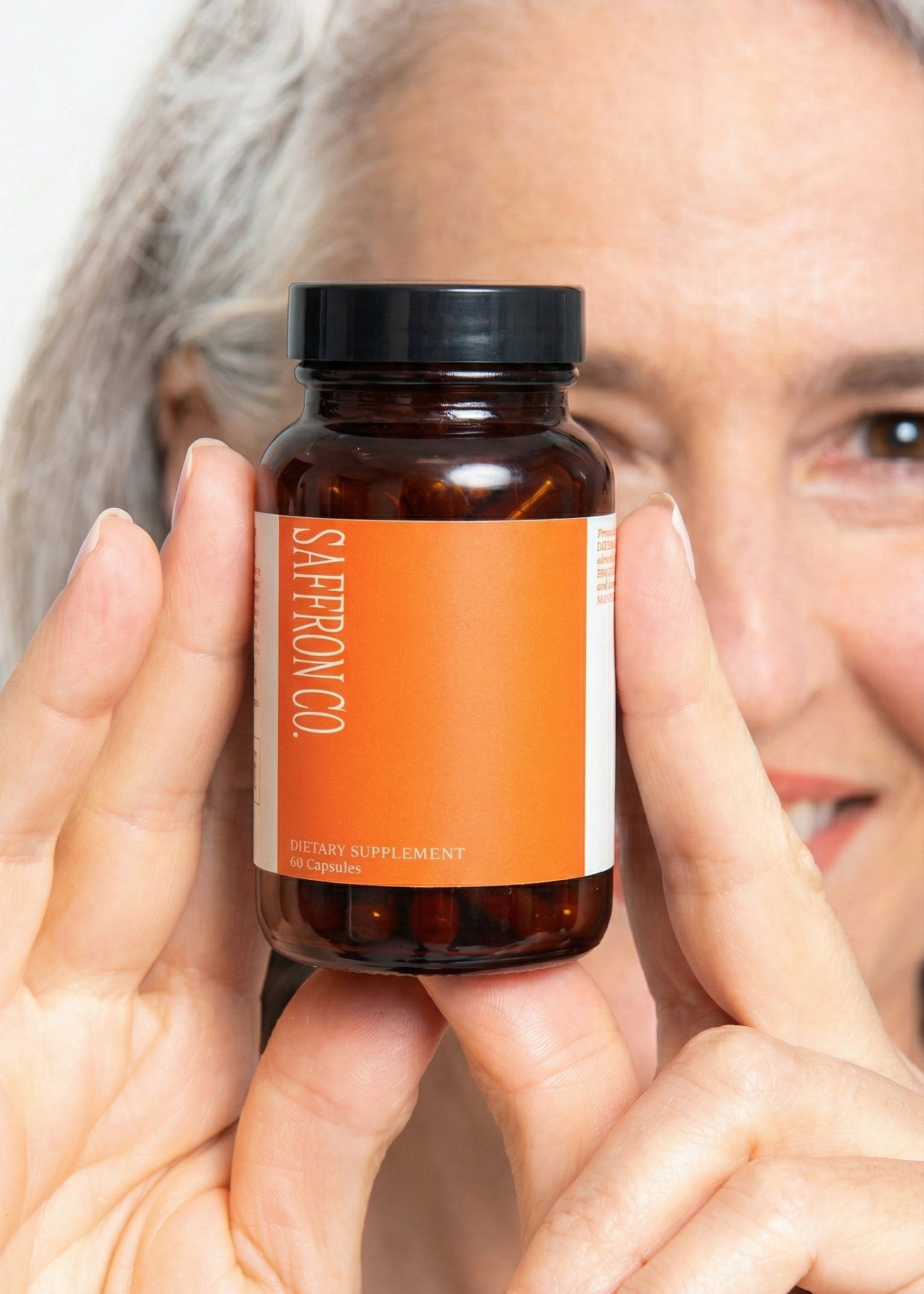
That is where a more complete formula can be worth considering. For example, Saffron Co Mood and Vitality Capsules use clinical-grade Spanish saffron at 30 mg per day, then pair it with Rhodiola rosea for stress adaptation, magnesium glycinate for nervous-system support, active-form vitamin B6 for neurotransmitter activation, and a probiotic for the gut-brain axis. The full formulation logic is explained on the why this formula page.
That does not make it the right fit for everyone. If you prefer a simple single-ingredient saffron product, that is a valid choice. But if your menopause symptoms span mood, stress, mental clarity, and low libido together, a broader stack may be more practical than buying several separate products. Saffron Co is also a newer brand, so it has less long-term independent brand history than some established competitors. The 90-day money-back guarantee is the brand's way of reducing that risk honestly.
Saffron side effects, safety, and realistic expectations
Saffron is generally well tolerated in research, but it is not risk-free for everyone.
The right expectation is moderate, not dramatic. Saffron may help support mood and well-being during menopause. It is unlikely to solve every symptom on its own.
If you are taking prescription medication for mood, sleep, or any other condition, talk with your healthcare provider before adding saffron. The same applies if you are pregnant or nursing. This article is for informational purposes and is not medical advice.
Common saffron side effects and tolerability
When side effects happen, they are usually mild. Some people report:
- digestive upset
- headache
- dizziness
- dry mouth
- changes in appetite
This is another reason not to overdo the dose. The research is built around about 30 mg per day. More is not better.
Can you take saffron with HRT or antidepressants?
This is a conversation to have with your healthcare provider, not a question to answer casually online.
Saffron may be compatible with many routines, but if you take antidepressants, sleep medication, HRT, birth control, or other prescriptions, it is smart to review the combination first. That is especially true when mood-related symptoms are involved.
When saffron may not be enough
Saffron may not be enough when symptoms are severe or quality of life is significantly affected.
If you are dealing with major sleep disruption, escalating anxiety, persistent low mood, loss of functioning, or menopause symptoms that are clearly dominating daily life, professional care deserves to come first. That may mean a conversation about HRT, a sleep-focused treatment plan, therapy, or a fuller medical workup. Supplements can still have a place, but they should not carry the whole burden.
Where saffron fits in a smart menopause support plan
Saffron makes the most sense as one tool within a broader menopause strategy.
That strategy still includes the basics that influence whether any supplement helps much at all: sleep, blood sugar stability, movement, stress regulation, and getting the right medical evaluation when symptoms point to hormones, thyroid issues, iron deficiency, or something else that needs attention.
Used in that context, saffron can be a thoughtful option. Not a miracle fix. Not a replacement for clinical care. But a clinically studied, non-hormonal daily ritual that may help some women feel more emotionally steady and more like themselves again.
Who saffron may be a good fit for
Saffron may be a good fit if you are in perimenopause or menopause and feel:
- emotionally flat
- more stress-reactive than usual
- less motivated or less resilient
- somewhat disconnected from yourself
- interested in a non-hormonal daily ritual with clinical support behind it
If that is your profile, a standardized saffron supplement may be worth considering. Buy Saffron Co if you want a more complete five-ingredient formula built around clinical-dose saffron and you value the 90-day guarantee. Consider a single-ingredient saffron product instead if you want the simplest possible approach.
Who may want a different path first
A different path may make more sense first if your symptoms are led by:
- dominant hot flashes or night sweats
- severe insomnia
- vaginal symptoms or pain with sex
- signs of a stronger hormone-related imbalance
- low mood or anxiety that feels clinically significant
In those cases, clinician-led evaluation, a discussion about HRT or other menopause care, or targeted sleep support may do more than saffron alone.
FAQ
Does saffron help menopause symptoms?
It may help support some menopause symptoms, especially mood changes, emotional flatness, stress reactivity, and possibly sleep quality and libido. The strongest evidence is for mood support, not for hot flashes or night sweats.
Does saffron increase estrogen?
No clear evidence shows that saffron increases estrogen. It is not considered a hormone replacement supplement. Its effects are thought to relate more to neurotransmitter and stress-support pathways.
How long does saffron take to work for menopause?
Most studies look at outcomes over 4 to 8 weeks of daily use. Some people notice changes sooner, but saffron is generally not a fast-acting supplement.
What is the best way to take saffron for menopause?
The best approach is usually a standardized saffron extract at about 28 to 30 mg per day, taken consistently. Culinary saffron is not a substitute for a measured supplement dose.
What are the most common saffron side effects?
The most commonly reported side effects are mild and can include digestive upset, headache, dizziness, dry mouth, and appetite changes. Saffron is generally well tolerated, but more is not better.
Can you take saffron with HRT or antidepressants?
Possibly, but you should speak with your healthcare provider first. That is especially important if you take antidepressants, sleep medication, hormone therapy, or any other prescription drug.
Read more

Discover the best perimenopause supplements for mood, sleep, brain fog, libido, and weight support. Learn what actually helps, what to skip, and how to choose wisely.

Learn why libido changes during perimenopause and what may help naturally. Explore causes, stress, hormones, supplements, intimacy support, and realistic solutions.