Looking for the best saffron supplement for ADHD-related focus support? Here is what the research actually shows, how to filter formulas by dose and standardization, and which products fit adults vs kids, evaluated separately because the standards are different.
What Makes a Saffron Supplement Worth Considering for ADHD?
Most focus supplements overpromise. That is especially true in ADHD-adjacent categories, where brands often lean on vague claims, flashy ingredients, and very little real dosing logic.
A better place to start is simpler: evidence, dose, standardization, safety, and label quality.
Saffron is being studied for attention, focus, and emotional regulation support. That is why interest has grown so quickly. But it is not a cure for ADHD, and it is not a replacement for prescribed treatment, behavioral support, therapy, school accommodations, or clinician-guided care.
The interest comes from two directions at once. Adults are searching for non-stimulant options that may help with distractibility, mental fatigue, brain fog, or emotional steadiness. Parents are searching for gentler support options too, which is why terms like saffron supplement for kids keep gaining traction. Those are not the same use cases, and they should not be evaluated the same way.
The framework this article uses: clinical dose, standardization, formula logic, safety, age fit, and label transparency. Every product pick below was evaluated against the published research range, the actual label, and the brand-stated guarantee, separately for adults and for kids, because the standards are different.
You can also review Saffron Co.'s formula philosophy if you want a clear example of how a saffron formula can be built around more than saffron alone.
Why So Many People Are Searching for the Best Saffron Supplement for ADHD
Interest in saffron has grown because many people want support without automatically jumping to stimulant-heavy formulas. Some are looking for help with focus. Others are dealing with overstimulation, emotional reactivity, or the mental fatigue that often overlaps with attention struggles.
That does not mean everyone searching has ADHD, or that saffron is the right tool for every case. It means readers are trying to sort through a crowded category and find something with a real evidence base behind it.
What This Article Can and Cannot Help You Do
This article can help you compare saffron supplement quality, understand what the research does and does not show, and narrow down which formula type makes sense for your situation.
It cannot diagnose ADHD. It cannot tell you whether saffron should replace a treatment plan. And it should not be used instead of clinician-guided care, especially for children, teens, or adults with significant impairment.
That distinction matters. Kids, teens, and adults need to be discussed separately because the evidence base and safety context are different.
What the Research Actually Says About Saffron and ADHD
The research on saffron and ADHD-related symptoms is promising, but still limited. That is the honest summary.
A small number of human studies suggest saffron may help support attention, hyperactivity-related measures, and emotional regulation in some people. Most of that research has been short in duration and relatively small in sample size. There is more discussion around children and adolescents than adults, which means the adult evidence base is still thinner than many headlines suggest.
In practical terms, saffron appears worth considering as a supportive option in some cases. It does not yet have the kind of large, long-term evidence base that would justify stronger conclusions.
How Saffron May Support Attention, Focus, and Emotional Regulation
Researchers generally point to a few mechanisms.
Saffron's key compounds, including crocin and safranal, appear to influence neurotransmitter signaling, especially serotonin and dopamine pathways. Those pathways are relevant to mood, motivation, focus, and emotional steadiness. Saffron also has antioxidant activity, which may support healthy brain signaling and nerve-cell resilience.
That does not mean saffron "treats ADHD." A more accurate framing is that it may help support normal attention and emotional regulation pathways in some people.
What Clinical Studies Have Found So Far
The main research themes are fairly consistent: small studies, short study periods, and encouraging but still preliminary findings.
Some trials have reported improvements on measures related to attention, hyperactivity, impulsivity, or emotional regulation. But most of these studies run only a few weeks to a few months. Sample sizes are not large. Follow-up is limited. And not all studies are designed the same way, which makes broad comparisons harder.
The honest read on the evidence: the signal is real enough to take seriously, but not strong enough to oversell. Saffron has early human research on attention and emotional-regulation measures, mostly in short, small studies. That makes it a candidate for supportive use within a broader plan, not a substitute for one.
Saffron ADHD Adults: What We Know and What We Still Do Not
If you are searching saffron adhd adults, the key point is this: adult interest is high, but adult-specific evidence is still developing.
Adult readers should be careful about assuming that findings in children or adolescents will translate directly. Adult ADHD often overlaps with stress, sleep issues, burnout, mood shifts, and hormone-related changes, especially in women. For women in perimenopause this overlap is the rule, not the exception: estrogen shifts affect the same dopamine signaling that attention runs on, which is why many women first notice focus problems in their 40s alongside mood and sleep changes, and why it is genuinely hard to tell where hormonal brain fog ends and attention deficit begins. That can make saffron feel relevant, but it also makes outcomes harder to predict, and it makes a clinician conversation more useful, not less.
For adults, saffron may make the most sense as a supportive option for focus, emotional balance, and stress resilience rather than as a stand-alone answer.
Best Saffron Supplement for ADHD Kids: Why the Standard Is Higher
Parents searching for the best saffron supplement for adhd kids need a stricter filter than adult shoppers.
The kids standard is higher, full stop. Child supplementation requires closer attention to dose appropriateness, delivery format, labeling, and clinician involvement. Adult capsules should not be casually repurposed for children by splitting doses. And products not clearly formulated or labeled for children should not be treated as child-ready. In this category, caution is a strength, not a drawback.
How to Choose the Best Saffron Supplement for ADHD
Before looking at brands, it helps to know what separates a serious saffron product from a weak one.
The best formula depends on the use case. Some people want pure saffron so they can test one variable at a time. Others want a broader formula that supports focus plus stress resilience, mood balance, or nervous-system support.
Either can be reasonable. The key is knowing what you are actually buying.
Start With Dose: Saffron for ADHD Dosage Adults Should Look For
When adult shoppers ask about saffron for adhd dosage adults, the most useful benchmark is the research range: roughly 28 to 30 mg per day.
That is where much of the saffron literature clusters. It is the most defensible starting point when comparing products. Higher doses are not automatically better. In fact, a front label shouting "extra strength" means very little if the formula is not aligned with the clinically studied range.
For adult shoppers, 30 mg per day is usually the first number worth checking.
Why Standardization Matters More Than Milligrams Alone
A capsule can say "saffron" on the label and still tell you almost nothing.
What matters is whether the extract is standardized. Look for markers such as crocin or safranal content. Those tell you far more about quality than generic saffron powder claims.
Clinically useful saffron extracts are not the same as culinary saffron or unlabeled raw material. If a label gives you milligrams but no standardization data, that is a reason to pause.
Single-Ingredient vs Multi-Ingredient Formulas
Pure saffron products appeal to people who want simplicity. They are easier to stack, easier to assess, and cleaner for testing individual response.
Multi-ingredient formulas can make more sense when the goal is broader. For example, some adults are not just looking for attention support. They are also dealing with stress reactivity, mood flattening, or nervous-system strain. In that context, added ingredients like magnesium, Rhodiola, B vitamins, probiotics, or calming amino acids may have a clear role.
The right choice depends on whether you want straightforward saffron or an all-in-one support stack.
What Quality Signals Actually Matter
Third-party testing matters. GMP certification matters. Allergen transparency matters. Clear serving instructions matter.
So does brand transparency. In a newer category like saffron for ADHD-related support, a refund policy can matter more than clever branding. It gives you a defined window to evaluate the product without assuming it will work for everyone.
Red Flags to Avoid
Watch for these warning signs:
- proprietary blends that hide actual ingredient amounts
- no standardization data for saffron
- claims that sound like a natural ADHD treatment promise
- stimulant-heavy formulas trying to ride on saffron's name
- child-marketed products using adult-style dosages
- vague labels that do not clearly state serving size or extract quality
Bottom line. In this category, restraint is usually a better sign than hype. The strongest saffron products name the daily dose, name the standardization markers, label the intended age group clearly, and back the product with a guarantee window long enough for a fair 4-8 week trial.
The Best Saffron Supplements for ADHD Support at a Glance
There is no single best saffron supplement for ADHD across every use case. The table below compares five products by fit: three for adults, two for kids. Adult and child products are not interchangeable, which is why the picks that follow are split the same way.
| Product | Best For | Saffron Dose & Format | Price | Key Actives |
|---|---|---|---|---|
 Dr. Brighten Radiant Mind Dr. Brighten Radiant Mind
|
Brain fog & memory support (adult women) | Affron® 30 mg/day / 2 caps with food | $49.95 one-time | Affron® saffron + Cognizin® citicoline 250 mg + Bacognize® bacopa 300 mg + zinc |
 Saffron Co. Mood & Vitality Saffron Co. Mood & Vitality
|
Perimenopause-related focus, mood & stress shifts (adult women) | 30 mg Spanish saffron (≥3.0% trans-crocin) / 1-2 caps AM | $69.90 one-time / $59.90 monthly sub / $119.92 90-day sub | Saffron + Rhodiola + magnesium glycinate + ProbioMood® NU-10 + B6 (P5P) |
 BrainMD Happy Saffron Plus® BrainMD Happy Saffron Plus®
|
Clinician brand familiarity (adults) | affron® saffron / 3 caps between meals | $51.45 one-time / from $38.59 6-unit sub | affron® + Longvida® curcumin 400 mg + zinc glycinate |
 Saffrosun® for Children Saffrosun® for Children
|
Child-specific saffron (ages 6-14) | Affron® 7-14 mg/day by age / caps can be opened into food | £20 GBP (UK brand; international shipping at checkout) | Affron® + algae vitamin D + B12 + baobab prebiotic |
 GoJoy Kids Focus Gummies GoJoy Kids Focus Gummies
|
Gummy format for kids | Saffron included (mg not surfaced on PDP) / gummy | $24.95 (sale; reg. $26.95) | Saffron + omega-3 + L-theanine + magnesium glycinate + inositol + zinc + B6 |
Reading the table. The three adult products all anchor on a 30 mg-range saffron dose, but with different supporting bets, and the difference matters most for women in perimenopause. Dr. Brighten pairs Affron® with two cognitive branded extracts, which makes it the brain-fog-and-memory specialist. Saffron Co. surrounds saffron with a stress-and-gut-brain stack, which matches the way perimenopause symptoms actually travel: focus drift arriving together with mood flatness, stress reactivity, and disrupted sleep. BrainMD adds clinical-dose curcumin under Dr. Amen's name. The two kids products take opposite approaches to transparency: Saffrosun for Children publishes its age-split Affron® dose (7-14 mg) and standardization, while GoJoy lists saffron among seven actives without surfacing the mg, which is the main thing to ask the brand before buying.
The Picks: Adults First, Then Kids
Best for Brain Fog and Memory Support: Dr. Brighten Radiant Mind
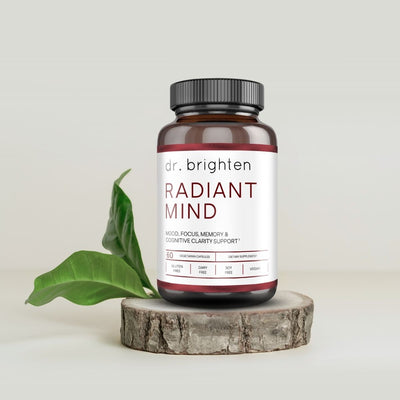
Dr. Brighten Essentials Radiant Mind
$49.95 one-time · 60 capsules / 30 servings · 2 capsules daily in the morning or early afternoon with food
Radiant Mind is the most cognition-focused saffron formula in this comparison. It pairs Affron® branded saffron at the clinically studied 30 mg dose with two other named branded extracts at meaningful doses: Cognizin® citicoline at 250 mg (studied for attention and mental energy) and Bacognize® bacopa at 300 mg (12% bacopa glycosides, the slow-build memory-and-learning extract), plus 10 mg zinc. The formulator, Dr. Brighten, is a recognized women's hormonal-health educator, and the product is positioned for women navigating stress, full schedules, and hormonal shifts. Where it earns its lane in this comparison is the cognition trio specifically: if the symptom you would name first is brain fog or memory slips rather than the broader mood-stress-sleep pattern, this is the most directly matched formula here. If your focus issues arrive bundled with emotional flatness, stress reactivity, and disrupted sleep, the broader stack below covers more of that pattern in one product.
- Affron® saffron 30 mg + Cognizin® citicoline 250 mg + Bacognize® bacopa 300 mg + zinc 10 mg
- Three named branded extracts, all at research-aligned doses
- Gluten-free, dairy-free, soy-free, non-GMO; third-party tested; made in USA
- 30-day refund policy; free shipping over $99
- Adult women's product; not formulated for children
Best for Perimenopause-Related Focus, Mood, and Stress Shifts: Saffron Co. Mood and Vitality
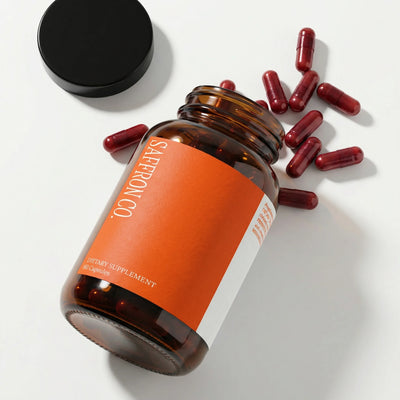
Saffron Co. Mood and Vitality Capsules
$69.90 one-time / $59.90 monthly sub (15% off) / $119.92 on the 90-Day Supply sub (43% off) · 60 capsules per jar · 1-2 capsules in the morning
For women in perimenopause, attention struggles rarely show up alone. Focus drift tends to arrive bundled with emotional flatness, stress reactivity, disrupted sleep, and the feeling of being unlike yourself, and that bundle is exactly what the Saffron Co. formula is built around. It uses 30 mg per day of Spanish saffron extract standardized to ≥3.0% trans-crocin and ~1.2% safranal, aligned with the clinical dosing range, then adds Rhodiola rosea 100 mg for stress adaptation, magnesium glycinate 140 mg (Albion TRAACS®) for nervous-system support, vitamin B6 5 mg in its active P5P form for neurotransmitter activation, and ProbioMood® NU-10 at 2 billion CFU to support the gut-brain axis. Where Dr. Brighten's formula goes deep on cognition specifically, Saffron Co. goes wide across the whole midlife pattern, which is the better match when you cannot point to one isolated symptom. It is not a child-focused formula, and it is not designed as a medication substitute. As a newer brand it has less long-term independent market history than some established competitors; the 90-day money-back guarantee is the clearest way the brand answers that limitation honestly.
- 30 mg Spanish saffron extract, ≥3.0% trans-crocin / ~1.2% safranal (research-aligned dose)
- 5-ingredient stack: saffron + Rhodiola + magnesium glycinate + ProbioMood® NU-10 + B6 (P5P)
- 1-2 capsules daily, taken in the morning (lightest capsule load in this set)
- Vegan, gluten-free, zero-filler; third-party tested by ISO-accredited labs
- 90-day money-back guarantee (longest written window in this comparison)
Best for Clinician Brand Familiarity: BrainMD Happy Saffron Plus

BrainMD Happy Saffron Plus®
$51.45 per bottle one-time / from $38.59 at the 6-unit subscription tier (25% off) · 3 capsules daily, between meals
BrainMD appeals to readers who place weight on established clinical brand identity. Dr. Daniel Amen's clinics, books, and media presence give Happy Saffron Plus the most public-facing clinician profile of any saffron product on the market. The formulation philosophy differs from a stack approach: three actives, with affron® branded saffron paired with 400 mg of Longvida® curcumin (the dose used in working-memory research) and zinc glycinate. The curcumin angle gives it a cognition story the other adult picks frame differently. The 3-capsule daily load is the heaviest here, and the money-back guarantee window is not surfaced in days on the product page, which is a transparency gap relative to a written 90-day policy. HSA/FSA eligibility via Truemed can meaningfully offset the cost if you have a health-savings account.
- affron® branded saffron + Longvida® curcumin 400 mg + zinc glycinate
- Formulated by Dr. Daniel Amen of Amen Clinics
- HSA/FSA eligible via Truemed (~30% average savings)
- Guarantee window not stated in days on the PDP
- Adult product; not formulated for children
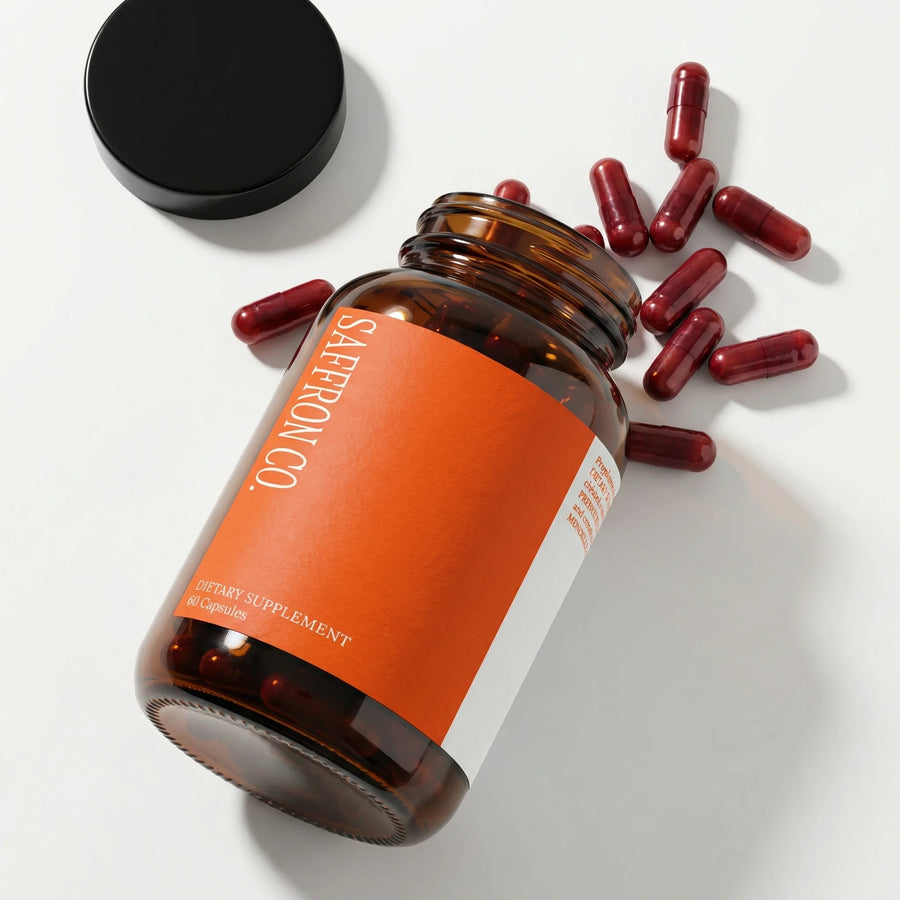
Built for the midlife pattern: focus, mood, and stress together.
Saffron Co. pairs research-aligned saffron with Rhodiola, magnesium glycinate, ProbioMood® NU-10, and active vitamin B6 (P5P) for women whose focus drift arrives alongside the mood, stress, and sleep shifts of perimenopause.
Best Saffron Options for Kids: A Stricter Filter
For kids, the best option is the one specifically formulated for children, clearly labeled for pediatric use, and reviewed with a pediatric clinician. That means age-appropriate dosing, delivery format, and labeling. It also means avoiding the common mistake of splitting adult capsules and assuming that creates a child-safe product.
Best Child-Specific Saffron Formula: Saffrosun for Children
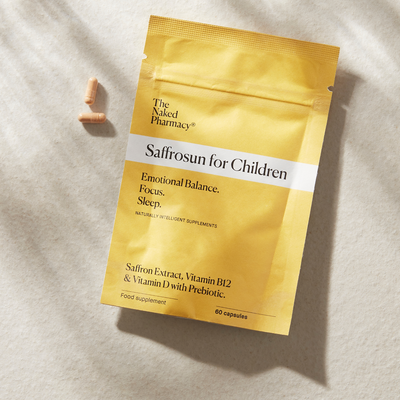
The Naked Pharmacy Saffrosun® for Children
£20.00 GBP · 60 capsules per pouch · Ages 6-9: 1 capsule daily / Ages 10-14: 2 capsules daily, with food
This is the only product in this comparison actually formulated and labeled for children, which makes it the default starting point for parents. The formula uses Affron® branded saffron at an age-split dose: 7 mg daily for ages 6-9 and 14 mg daily for ages 10-14, roughly a quarter to half the adult research dose, standardized to ≥3.5% crocin and ≥0.2% safranal. Supporting ingredients are conservative and food-sourced: algae-derived vitamin D, shiitake-derived B12, and baobab as a prebiotic. Capsules can be opened and mixed into food or drink, which solves the swallowing problem for younger kids. Pharmacist-formulated, vegan certified, with the brand citing more than 6 clinical trials behind Affron®. Two practical caveats: it is a UK brand priced in GBP (international shipping calculated at checkout), and the PDP does not surface a return window or third-party testing details, so US parents should check both before ordering.
- Affron® saffron, age-split dosing: 7 mg/day (ages 6-9) or 14 mg/day (ages 10-14)
- Standardized to ≥3.5% crocin, ≥0.2% safranal
- Algae vitamin D + shiitake B12 + baobab prebiotic; vegan certified
- Capsules open into food or drink for easier dosing
- UK brand, £20 GBP; verify international shipping and returns before ordering
Best Gummy Format for Kids: GoJoy Kids Focus Gummies
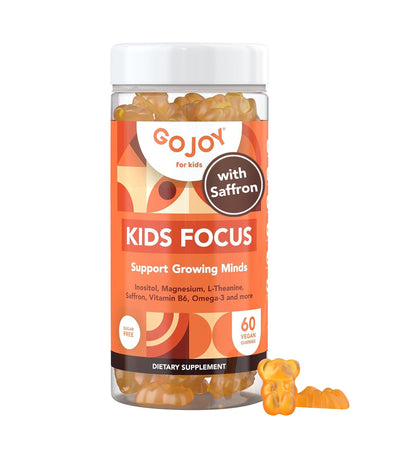
GoJoy Naturals Kids Focus Gummies
$24.95 (sale; regularly $26.95) · 7-in-1 focus and concentration formula
For kids who will not take capsules even opened into food, GoJoy's gummy is the saffron-containing format play. The 7-in-1 blend includes saffron alongside omega-3 fatty acids, L-theanine, magnesium glycinate, inositol, zinc, and vitamin B6, a sensible ingredient roster for a kids' focus product, and the gummies are sugar-free, vegan, gluten-free, non-GMO, and soy-free, with third-party testing and a 90-day guarantee (the longest in the kids set). The transparency trade-off is real, though: the product page does not surface the mg per ingredient, the serving directions, or the target age range. Per the framework this article uses, that is the main question to put to the brand before buying, because a saffron dose you cannot see is a saffron dose you cannot evaluate against the research.
- 7-in-1: saffron + omega-3 + L-theanine + magnesium glycinate + inositol + zinc + B6
- Sugar-free gummy; vegan, gluten-free, non-GMO, soy-free
- Third-party tested; 90-day guarantee
- Per-ingredient mg, serving directions, and age range not surfaced on the PDP; ask the brand
A note on non-saffron calm gummies. Popular kids' calm products like Olly Kids Chillax (magnesium, L-theanine, lemon balm; NSF certified; about $13.99) contain no saffron at all. They may still be reasonable general-calm options to discuss with your pediatrician, but they do not belong in a saffron evaluation, and a "calm" gummy is not the same thing as the attention-and-emotional-regulation support the saffron research describes.
Which Supplement Is the Best Fit for Your Situation?
A quick decision guide:
- Woman in perimenopause whose focus drift arrives with mood flatness, stress reactivity, or disrupted sleep: the broader Saffron Co. stack is built for exactly that bundle
- Woman whose first-named symptom is brain fog or memory slips specifically: Dr. Brighten Radiant Mind's cognition trio (Cognizin® + Bacognize® + Affron®) is the most directly matched formula
- Adult who values established brand familiarity: BrainMD (or a pure saffron product from a long-standing brand like Life Extension) may feel more comfortable
- Parent considering a saffron supplement for kids: Saffrosun for Children is the only child-labeled saffron product here; involve a pediatric clinician either way
- Reader with severe symptoms or diagnostic uncertainty: supplement shopping is probably not the first step
There is no universal best saffron supplement for ADHD. There is only the best fit for a specific goal, age group, and context.
How to Take Saffron Safely, What to Expect, and When to Look Elsewhere
Saffron is not an instant-effect stimulant. Response varies. Some people notice meaningful support. Some notice modest changes. Some do not respond at all.
That is normal, and it is one reason hype is so unhelpful in this category.
How Long Does Saffron Take to Work for Focus Support?
Most saffron research and real-world use point to several weeks of consistent use, not a same-day effect.
A fair trial window is usually 4 to 8 weeks. That gives you enough time to evaluate whether the supplement is helping with focus, emotional steadiness, or mental clarity. Switching products too quickly makes it hard to know what is actually working.
Possible Side Effects and Interactions to Know About
Saffron is generally well tolerated in studied amounts, but mild side effects can happen. These may include digestive upset, headache, or individual sensitivity.
If you take prescription medication for ADHD, mood, sleep, or any other condition, speak with your healthcare provider before adding saffron. The same applies if you are pregnant or nursing. This article is for informational purposes only and is not medical advice.
That conversation matters even more for children and teens, where the margin for casual experimentation should be smaller.
When a Supplement Is Not the Right Tool
A supplement is not the right tool when symptoms are severe, daily functioning is clearly impaired, diagnosis is uncertain, or medication questions are on the table.
It is also not the right tool for sorting out major child behavior concerns without pediatric guidance.
Saffron may be a supportive option within a broader plan. It is not a stand-in for diagnosis, behavioral support, therapy, school accommodations, or prescribed care.
Final Buying Takeaway
If you are trying to choose the best saffron supplement for ADHD, use this order:
- research-aligned dose
- standardized extract
- transparent label
- age-appropriate formula
- realistic expectations
Buy if the formula matches your actual use case. Consider a simpler pure saffron product if you want cleaner testing, or a child-specific option if you are shopping for a younger user. And if the situation is more complex than supplement support can realistically address, seek clinician guidance first.
Birthed by nature. Backed by science.
Try Saffron Co. for a full 4 to 8 week evaluation window, the timeline the saffron research actually uses. If you do not feel the difference, get your money back. No questions asked.
FAQ: Saffron Supplements and ADHD
Does saffron actually help with ADHD symptoms?
It may help support attention, focus, and emotional regulation in some people, based on early human research. But the evidence is still limited, and saffron is not a treatment for ADHD or a replacement for prescribed care.
What is the best saffron supplement for ADHD in adults?
It depends on the use case. Women in perimenopause whose focus drift arrives together with mood, stress, and sleep shifts may prefer a broader multi-ingredient formula like Saffron Co. Women whose first-named symptom is brain fog or memory may be better matched by a cognition-focused formula like Dr. Brighten Radiant Mind. Adults who want simplicity and easier self-testing may do better with a pure saffron extract at a research-aligned dose.
What is the right saffron for ADHD dosage for adults?
Most research clusters around 28 to 30 mg per day. For adult shoppers, that is the most useful benchmark. More is not automatically better.
How long does saffron take to work for focus and attention?
Usually several weeks, not hours. A reasonable evaluation window is 4 to 8 weeks of consistent daily use.
Is there a safe saffron supplement for kids, or should parents avoid adult formulas?
Parents should avoid assuming adult formulas are suitable for children. The safer route is a child-specific product with clear pediatric labeling, such as Saffrosun for Children with its age-split 7-14 mg Affron® dosing, reviewed with a pediatric clinician before use.
Can you take saffron with ADHD medication?
Do not assume yes without checking. If you take ADHD medication, antidepressants, sleep medication, or other prescriptions, talk with your healthcare provider before adding saffron.
Product prices and specifications verified against each brand's product page at time of writing and may move; Saffrosun for Children is priced in GBP by a UK brand. Read the label on the bottle you actually buy, since formulas get reformulated. This article is for informational purposes only and is not medical advice. Saffron supplements are not a treatment for ADHD and are not a replacement for diagnosis, prescribed medication, behavioral support, therapy, or school accommodations. If you or your child take prescription medication, or if you are pregnant or nursing, talk with a qualified healthcare provider before starting a new supplement. These statements have not been evaluated by the Food and Drug Administration. These products are not intended to diagnose, treat, cure, or prevent any disease.