Saffron and ashwagandha both sit in the mood-and-stress category, but they are not interchangeable. Here is what each herb actually does, which symptom pattern points to which, and whether they make sense together.
Saffron vs Ashwagandha at a Glance
People compare saffron and ashwagandha because both sit in the mood-and-stress category. But they are not interchangeable.
At a high level, saffron is often the better fit for emotional flatness, mood balance, focus drift, and libido support. Ashwagandha is often the better fit for feeling chronically wired, stressed, tense, or sleep-deprived.
That does not make one universally better. The right choice depends on what your days actually feel like. Are you flat, dulled, and unlike yourself? Or are you overstimulated, tired-but-wired, and unable to come down at night? Those are different problems, and these herbs tend to help in different ways.
Both can be useful. Both have real limitations. And both depend heavily on dose, extract quality, and individual sensitivity.
How to read this comparison: we treat saffron and ashwagandha as different tools for different problems, not as competitors. The right answer is whichever herb matches the symptom pattern you are actually living with. The side-by-side table below makes the differences concrete across 12 dimensions.
Jump to the side-by-side table →
Quick answer: which one is better for what?
- Mood and emotional well-being: Saffron usually has the edge
- Stress resilience: Ashwagandha is often the stronger fit
- Sleep support: Ashwagandha tends to fit better, especially when stress is the main driver
- Focus and mental clarity: Saffron is often the better choice
- Libido support: Saffron has the more relevant discussion here
- Daily energy: Saffron may feel more uplifting or clarifying, while ashwagandha may feel more calming
What Saffron and Ashwagandha Actually Do in the Body
Saffron is best known for being clinically studied for mood support. Its key compounds, especially crocin and safranal, appear to influence serotonin and dopamine signaling, while also providing antioxidant activity and possible support for BDNF, a factor involved in brain-cell health and plasticity. In plain language, saffron is usually discussed as a mood-supportive herb with a slightly brightening or clarifying feel.
Ashwagandha works differently. It is an adaptogen, meaning it is used to help the body adapt to stress. Most of the conversation around ashwagandha centers on cortisol, stress-response regulation, and its calming effect on the nervous system. It is often chosen by people who feel revved up, tense, depleted, or unable to switch off.
The overlap is real, but partial. Saffron is not simply a calming herb. Ashwagandha is not simply a mood herb. One leans more uplifting and emotionally supportive. The other leans more stress-buffering and calming. This is also why formulation quality matters. When people compare supplements (not raw herbs), the details matter: standardized extracts, clinically relevant dosing, and whether the formula actually matches the use case.
Saffron for mood, motivation, and emotional balance
Saffron has been studied most often in the 28 to 30 mg daily range, which is why that dose matters so much when evaluating a supplement. The compounds most often discussed are crocin and safranal, both of which are used as quality markers in standardized extracts.
This is why saffron comes up so often in conversations about feeling flat, dulled, or just not quite like yourself. It is less about sedation and more about helping support mood balance, emotional well-being, and mental clarity with consistent use.
Ashwagandha for stress response and nervous-system load
Ashwagandha is usually used for a different pattern: chronic stress, nervous-system overload, tension, and stress-related sleep trouble. Its adaptogenic role is the main point. People often take it because they feel like their system never fully powers down.
That said, response varies. Some people find it calming and grounding. Others feel too sedated, foggy, or emotionally blunted on it. That does not mean ashwagandha is a poor herb. It means calming herbs are not neutral for everyone.
Saffron vs Ashwagandha: A 12-Point Side-by-Side
The bullet-list quick answer above is the headline. This table is the receipt. Twelve dimensions where the two herbs differ in meaningful ways, with saffron on the left and ashwagandha on the right.
| Dimension | Saffron (Crocus sativus) | Ashwagandha (Withania somnifera) |
|---|---|---|
| Primary use case | Mood balance, emotional well-being, focus, libido | Stress resilience, nervous-system tension, sleep |
| Mechanism | Influences serotonin and dopamine signaling; antioxidant; supports BDNF | Adaptogen; supports cortisol and stress-response regulation; calms the nervous system |
| What it feels like | Brightening, clarifying, more uplifted with consistent use | Calming, grounding, more settled and less reactive |
| Clinically studied daily dose | ~28-30 mg of standardized extract | ~300-600 mg of standardized extract (varies by extract) |
| Standardization markers | trans-crocin, safranal | Withanolides (typically 1.5% to 5%, higher in branded extracts) |
| Named branded extracts | affron®, Satiereal®, Safr'Inside | KSM-66®, Sensoril®, Shoden® |
| Best for symptom pattern | Flat, dulled, low spark, unmotivated, "not like yourself" | Wired, tense, racing thoughts, unable to switch off |
| Sleep angle | Indirect; sleep may improve as mood and stress reactivity settle | More direct, especially when sleep disruption is stress-linked |
| Libido angle | Stronger relevance, particularly for stress-linked or midlife low desire | Less consistent; some report calming effect helps, some report less drive |
| Time to noticeable effect | 4-8 weeks of consistent daily use is the realistic window | 2-4 weeks for stress and sleep is common; mood effects can take longer |
| Common side effects | Mild digestive upset, headache, dizziness in some users | Drowsiness, GI upset, possible emotional blunting at higher doses |
| Special precautions | Pregnancy, prescribed mood medication; otherwise generally well tolerated | Thyroid considerations, pregnancy, sedating medication interactions |
Reading the table: the cleanest divide is brightening vs calming. Saffron leans uplifting and is anchored to a fairly tight clinical dose (28-30 mg/day) with two specific quality markers (trans-crocin, safranal). Ashwagandha leans calming, runs across a wider dose range, and varies a lot by branded extract. Saffron has the more direct libido story. Ashwagandha has the more direct stress-and-sleep story. If you cannot tell which one fits, the answer is usually whichever description above feels closer to what your day actually feels like.
Saffron vs Ashwagandha for Mood, Stress, Sleep, Focus, and Libido
This comparison makes more sense when built around real use cases, not ingredient mythology.
For many women in perimenopause, menopause, burnout, or high mental-load seasons, the question is not "Which herb is better?" It is "Which one matches what I am actually feeling?"
If you feel emotionally muted, unmotivated, and unlike yourself, saffron often makes more sense. If you feel frazzled, tightly wound, and unable to recover, ashwagandha may be the better place to start.
For mood support and feeling less flat
Saffron is often the better fit for low-grade emotional flatness, reduced enjoyment, and that hard-to-describe feeling of moving through life without much color in it. This is where its mood-supportive profile stands out.
Ashwagandha can still help mood indirectly when low mood is closely tied to stress overload. But if the core issue is "I want to feel like myself again," saffron is usually the stronger match.
For stress, anxiety-like tension, and feeling wired
Ashwagandha often fits better when the dominant pattern is chronic stress, physical tension, racing thoughts, or difficulty settling down. It is one of the more common adaptogens people reach for when their stress response feels overactive.
Saffron may still help support mood balance under stress, but it is not the primary stress herb for everyone. If the main problem is that your system feels stuck in overdrive, ashwagandha often makes more intuitive sense.
For sleep, focus, brain fog, and libido
For sleep, ashwagandha tends to be the more natural fit, especially when stress is disrupting your evenings.
For focus and brain fog, saffron often has the edge. It is more likely to appeal to people who want clearer thinking without feeling flattened.
For libido, saffron is the more relevant herb to look at, particularly where low desire overlaps with stress, emotional flatness, or midlife shifts. Ashwagandha does not fill that same niche as consistently, and some people report the opposite experience if it feels too calming.
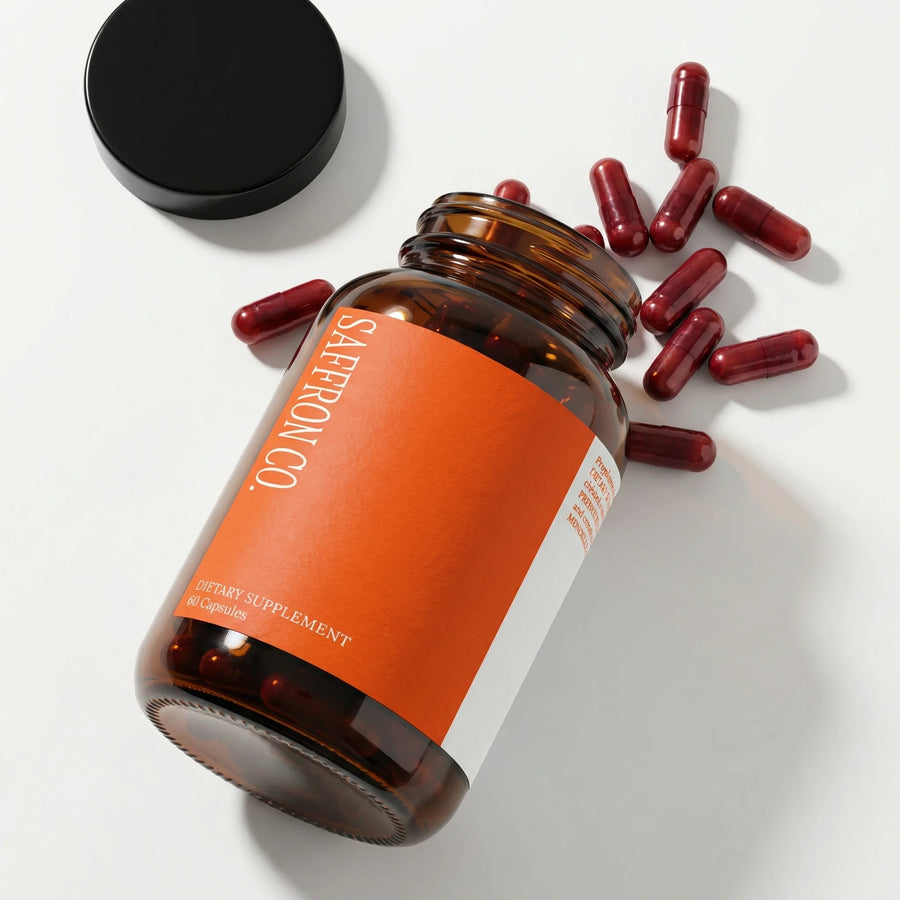
If saffron fits your pattern, the formulation matters next.
Saffron Co. uses the studied 30 mg daily dose of Spanish saffron extract, standardized to ≥3.0% trans-crocin and ~1.2% safranal, paired with Rhodiola for stress adaptation, magnesium glycinate for nervous-system support, ProbioMood® NU-10 for the gut-brain axis, and active vitamin B6 (P5P) for neurotransmitter activation.
Can You Take Saffron and Ashwagandha Together?
Yes, some people do combine them, and the logic is understandable. The mechanisms are different. One aims more at mood and emotional well-being. The other aims more at stress adaptation.
Still, more ingredients is not automatically better.
A saffron and ashwagandha supplement is usually trying to do one thing: pair mood support with stress buffering. Some formulas also add ingredients like magnesium or L-theanine to push the blend toward calm focus.
That can be useful. But the same rules still apply. Judge the formula by the extract quality, the dose of each ingredient, and whether the blend actually matches the intended use.
Who might consider combining them
A combination may appeal to people dealing with stress-driven low mood, burnout, or that common midlife mix of emotional flatness during the day and frazzled evenings at night.
If someone wants both emotional support and calmer evenings, combining them can make sense in theory. In practice, starting one at a time is often the cleaner way to assess response.
When combining them may not be the best first move
If you are sensitive to calming herbs, already take several supplements, or want to know what is actually helping, combining them from day one may not be the best move.
Starting with a single herb gives you better signal. If it helps, you know why. If it does not, you can adjust without guessing which ingredient is causing what.
Safety, Side Effects, and Realistic Expectations
Neither herb works overnight for most people. Neither is dramatic for everyone. And natural does not mean side-effect free.
Saffron is generally well tolerated, but some people report digestive upset, headache, or dizziness. Ashwagandha can also be well tolerated, but it is more likely to raise questions around drowsiness, stomach upset, or feeling too subdued. It also comes with more discussion around thyroid considerations than saffron does.
Realistic expectations matter. Neither saffron nor ashwagandha is a replacement for prescribed medication, therapy, or proper evaluation for persistent or severe symptoms. Neither herb can fix deeper drivers on its own. They cannot solve major sleep deprivation, untreated hormonal imbalance, grief, relationship strain, or diagnosable mental-health conditions. They may help support the system underneath. They do not replace broader care when broader care is needed.
If you are pregnant, nursing, taking prescription medication, or managing a thyroid condition, it is worth checking with your healthcare provider before adding either herb. The same caution applies if you take medication for mood, anxiety, sleep, or any other ongoing condition. This article is for informational purposes and is not medical advice.
How long do saffron and ashwagandha take to work?
Saffron is usually judged over 4 to 8 weeks, because that is the timeline used in much of the clinical research.
Ashwagandha may feel noticeable sooner for some people, especially around stress and sleep. But even then, it is better judged over a few weeks of consistent use rather than a few days.
How to Choose Between Saffron and Ashwagandha
There is no single winner here. There is only the better fit for your symptom pattern.
Choose saffron if the main issue is emotional flatness, low spark, focus drift, or libido support. Consider ashwagandha if the main issue is chronic stress, tension, stress-related sleep disruption, or feeling permanently wound up.
Some people also prefer a more complete saffron-based formula rather than saffron alone, especially if they want mood support plus stress resilience, nervous-system support, and gut-brain-axis support in one routine. In that case, a formula like Saffron Co. Mood and Vitality Capsules may be worth considering. It uses clinical-grade Spanish saffron at the studied 30 mg daily dose, alongside Rhodiola for stress adaptation, magnesium glycinate for nervous-system support, vitamin B6 in its active P5P form, and a probiotic to support the gut-brain axis. For readers weighing formulation depth, the full reasoning is explained on why this formula works. As a newer brand, Saffron Co. has less long-term independently published brand history than some established competitors, but the 90-day money-back guarantee makes trying it lower risk if the formula fit is right.
The simple decision rule. If your dominant feeling is flat or dulled, start with saffron. If your dominant feeling is wired or tense, start with ashwagandha. If both patterns travel together for you, a broader formula that anchors on saffron with stress-supporting partner ingredients is the cleaner third option. Start one thing at a time, give it 4 to 8 weeks, then adjust.
A simple decision checklist
Choose saffron if:
- Your main symptom is feeling flat, muted, or unlike yourself
- You want support for mood balance, focus, or libido
- You prefer something that feels more clarifying than sedating
- You are wary of herbs that may feel too calming
Choose ashwagandha if:
- Your main symptom is stress overload or physical tension
- Sleep disruption seems tied to stress reactivity
- You want something more calming, especially later in the day
- You generally tolerate calming herbs well
Consider a broader stack if:
- You want saffron as the foundation but also want support for stress resilience and nervous-system load
- You would rather take one well-designed formula than manage several separate products
Birthed by nature. Backed by science.
Try Saffron Co. for a full 4 to 8 week evaluation window, the timeline most saffron mood research uses. If you do not feel the difference, get your money back. No questions asked.
FAQ: Saffron vs Ashwagandha
Is saffron better than ashwagandha for mood?
Usually, yes, if the mood issue looks like emotional flatness, low enjoyment, low spark, or wanting to feel like yourself again. Ashwagandha may still help when low mood is closely tied to chronic stress, but saffron is more often the better fit for direct mood support.
Can you take saffron and ashwagandha together?
Some people do, because they work through different mechanisms. But it is often smarter to start one at a time so you can judge response clearly. If you combine them, pay attention to dose, extract quality, and how calming the blend feels for you.
Which is better for stress and sleep, saffron or ashwagandha?
Ashwagandha is often the better fit for chronic stress and stress-related sleep issues. Saffron may still support mood balance during stressful periods, but it is usually not the first herb people choose for feeling wired at night.
How long does saffron vs ashwagandha take to work?
Saffron is usually assessed over 4 to 8 weeks of consistent daily use. Ashwagandha may feel noticeable sooner for some people, especially for stress and sleep, but it still tends to work best when taken consistently for a few weeks.
Is an ashwagandha and saffron supplement worth it?
It can be, if you want both mood support and stress adaptation in one formula. But combination products are only worth it when the doses are meaningful and the ingredients match your actual goal. More ingredients alone does not make a formula better.
What is the difference between saffron and ashwagandha benefits?
Saffron is more often chosen for mood balance, emotional well-being, focus, and libido support. Ashwagandha is more often chosen for stress resilience, calming the nervous system, and stress-related sleep issues. They overlap, but they do not feel the same in real use.
This article is for informational purposes and is not medical advice. If you take prescription medication, are pregnant or nursing, or are managing a clinical condition (including thyroid disease), talk with a qualified healthcare provider before starting saffron, ashwagandha, or any new supplement. These statements have not been evaluated by the Food and Drug Administration. These products are not intended to diagnose, treat, cure, or prevent any disease.