Saffron and L-theanine sit in the same wellness aisle but solve different problems. Saffron is a slow-build mood ingredient. L-theanine is a same-day calm-focus ingredient. Here is how to tell which one fits what you are actually trying to support.
Saffron vs L-Theanine at a Glance
If you are comparing saffron vs L-theanine, you are probably asking a simple question that gets messy fast: which one will actually help you feel better?
Both are popular for feeling calmer, more mentally steady, and less overwhelmed. But they are not interchangeable. Saffron is a botanical extract that has been clinically studied for mood support, especially at around 28 to 30 mg per day taken consistently over several weeks. L-theanine is an amino acid found in tea that is better known for promoting calm focus more quickly, often within the same day.
That difference matters. If your main goal is baseline mood support, feeling less flat, or rebuilding a sense of emotional steadiness, saffron is usually the more relevant ingredient. If your goal is acute calm, less mental chatter, smoother focus, or fewer caffeine jitters, L-theanine often makes more sense.
Both have useful research behind them. Neither is a cure-all. And with both, results vary by person.
How to read this comparison: we are treating saffron and L-theanine as two tools for two different problems, not as competitors. Saffron is the slow-build mood ingredient. L-theanine is the same-day calm-focus ingredient. The side-by-side table below makes the differences concrete across 12 dimensions.
Jump to the side-by-side table →
Quick answer: what is the difference between saffron and L-theanine?
Saffron is a clinically studied botanical used mainly for mood support over weeks of daily use. L-theanine is an amino acid known for promoting calm focus more quickly, often within 30 to 60 minutes. In practical terms, saffron is usually chosen for emotional well-being and stress resilience over time, while L-theanine is more often used for same-day calm attention.
Who this comparison is really for
This comparison is most useful for people who feel flat, stressed, mentally noisy, unfocused, or not quite like themselves. That includes many women in perimenopause or menopause, where mood shifts, brain fog, and stress reactivity often overlap.
If that is you, it helps to know which ingredient fits which problem. For a deeper look at how a broader saffron-based formula is structured, Saffron Co.'s formula page explains why certain supporting ingredients are paired with saffron rather than used alone.
How Saffron and L-Theanine Work in the Body
Saffron and L-theanine influence different systems in the body, which is why they tend to feel different in real life.
Saffron is usually discussed in the context of mood and emotional well-being. L-theanine is more often discussed in the context of relaxed alertness. There is some overlap, especially around stress and mental clarity, but the mechanisms are not the same and the research base for each is shaped by different use cases.
How saffron may support mood balance
Saffron comes from Crocus sativus, and its best-studied compounds include crocin, crocetin, and safranal. Research suggests these compounds may help support serotonin and dopamine signaling, antioxidant activity in nerve cells, and pathways related to brain-derived neurotrophic factor (BDNF), which is involved in neuronal health and plasticity.
Most saffron research on mood uses a dose around 28 to 30 mg per day. That is the range where the evidence is most developed. The pattern across studies is not instant calm. It is gradual support for mood balance with consistent use, usually over 4 to 8 weeks.
That is why saffron is often a better fit for feeling emotionally flat, low-grade stress that has become your baseline, or the sense that your spark has gone missing.
How L-theanine promotes calm focus
L-theanine is an amino acid naturally found in tea, especially green tea. It is known for promoting relaxed alertness rather than sedation. That distinction is important. Most people do not take L-theanine because they want to feel sleepy. They take it because they want their mind to feel less noisy without becoming dull.
Research has linked L-theanine with alpha brain wave activity, which is associated with a calm but awake mental state. It also appears to influence neurotransmitter systems involved in attention and relaxation, including GABA, dopamine, and glutamate balance.
In practice, L-theanine is often used for acute stress, caffeine jitters, pre-meeting tension, overstimulation, or focus support. It is especially common alongside caffeine because it can make stimulation feel smoother and less edgy.
Why they do not feel the same. Saffron is usually a slower, cumulative ingredient. L-theanine is usually a faster, situational ingredient. That does not mean one is better overall. It means they serve different roles. Saffron is often chosen for baseline emotional steadiness. L-theanine is often chosen for situational tension, overstimulation, or calm concentration.
Saffron vs L-Theanine: A 12-Point Side-by-Side
The bullet-list quick answer above is the headline. This table is the receipt. Twelve dimensions where the two ingredients differ in meaningful ways, with saffron on the left and L-theanine on the right.
| Dimension | Saffron (Crocus sativus) | L-Theanine (from tea) |
|---|---|---|
| Source | Dried stigmas of the Crocus sativus flower (three per flower, harvested by hand) | Amino acid naturally found in tea, especially green tea (also synthesized for supplements) |
| Primary use case | Mood balance, emotional well-being, focus, libido | Calm focus, situational stress relief, smoother attention |
| Mechanism | Influences serotonin and dopamine signaling; antioxidant; supports BDNF | Promotes alpha brain wave activity; influences GABA, dopamine, and glutamate balance |
| What it feels like | Brightening, clarifying, more emotionally steady with consistent use | Calm without sedation; less mental noise; smoother under stimulation |
| Time to noticeable effect | 4-8 weeks of consistent daily use | 30-60 minutes after a single dose |
| Clinically studied daily dose | ~28-30 mg of standardized extract | ~100-400 mg per dose, often 200 mg |
| Standardization markers and branded extracts | trans-crocin and safranal; branded: affron®, Satiereal®, Safr'Inside | L-theanine purity %; Suntheanine® is the best-known branded form |
| Best for symptom pattern | Flat, dulled, low spark, "not like yourself" | Mentally noisy, overstimulated, jittery, pre-task tension |
| Pairs well with | Rhodiola, magnesium glycinate, active vitamin B6 (P5P), probiotics | Caffeine (the classic combination), magnesium |
| Sleep angle | Indirect; sleep may improve as mood and stress settle over time | More direct for quieting mental chatter at bedtime, especially in evenings |
| Common side effects | Mild GI upset, headache, dizziness in some users | Generally very well tolerated; rare GI upset at high single doses |
| Best use-case framing | Baseline emotional support, taken consistently over weeks | Situational calm focus, taken when you need it |
Reading the table. The clearest divide is timeline. Saffron is a 4-8 week cumulative ingredient at a tight 28-30 mg daily dose with two specific quality markers (trans-crocin, safranal). L-theanine is a 30-60 minute situational ingredient at a much wider dose range. Saffron has the deeper mood-and-libido story. L-theanine has the cleaner calm-focus story, especially paired with caffeine. If you cannot decide between them, the question to ask is whether you want something that builds slowly into your baseline or something you reach for when you need it.
Saffron vs L-Theanine for Mood, Stress, Focus, and Sleep
The better question is not which one wins. It is which one fits what you are actually trying to support.
For low mood or feeling emotionally flat
Saffron is usually the stronger fit here.
This is where the clinical research is most developed, particularly for mood support and emotional well-being at the 30 mg per day dose range. If your main issue is feeling flat, disconnected, or less like yourself, saffron generally makes more sense than L-theanine.
L-theanine may still help if stress and mental tension are feeding into that low-mood feeling. But it is not usually the first ingredient chosen for core mood support.
For stress and feeling wound up
L-theanine often has the edge for short-term stress, overstimulation, or a busy mind that needs calming without drowsiness.
If you know the feeling of being mentally revved up, overly stimulated, or unable to settle into one task, L-theanine is often the more direct match. It can be especially useful when stress feels immediate and situational.
Saffron may help support stress resilience over time, particularly when mood and stress are tangled together. But it is less of a same-day ingredient and more of a steady-use one.
For focus and mental clarity
L-theanine is usually better for calm concentration, especially when paired with caffeine.
That pairing is popular for a reason. It can make focus feel cleaner and less jittery. Saffron may still play a role in mental clarity, but usually in a broader way by supporting mood balance and helping the body adapt to stress.
If brain fog is being driven by sleep loss, hormonal shifts, burnout, or chronic overload, neither ingredient fully solves the root issue on its own. They may help support the edges of the problem, but they do not override the deeper drivers.
For sleep and evening calm
L-theanine is more commonly used for winding down, especially when the problem is mental chatter rather than physical restlessness.
Saffron is not primarily a sleep supplement. Some people may sleep better indirectly when mood and stress improve, but it should not be expected to work like a sedative. If your main goal is evening calm or a quieter mind before bed, L-theanine is usually the more natural fit.
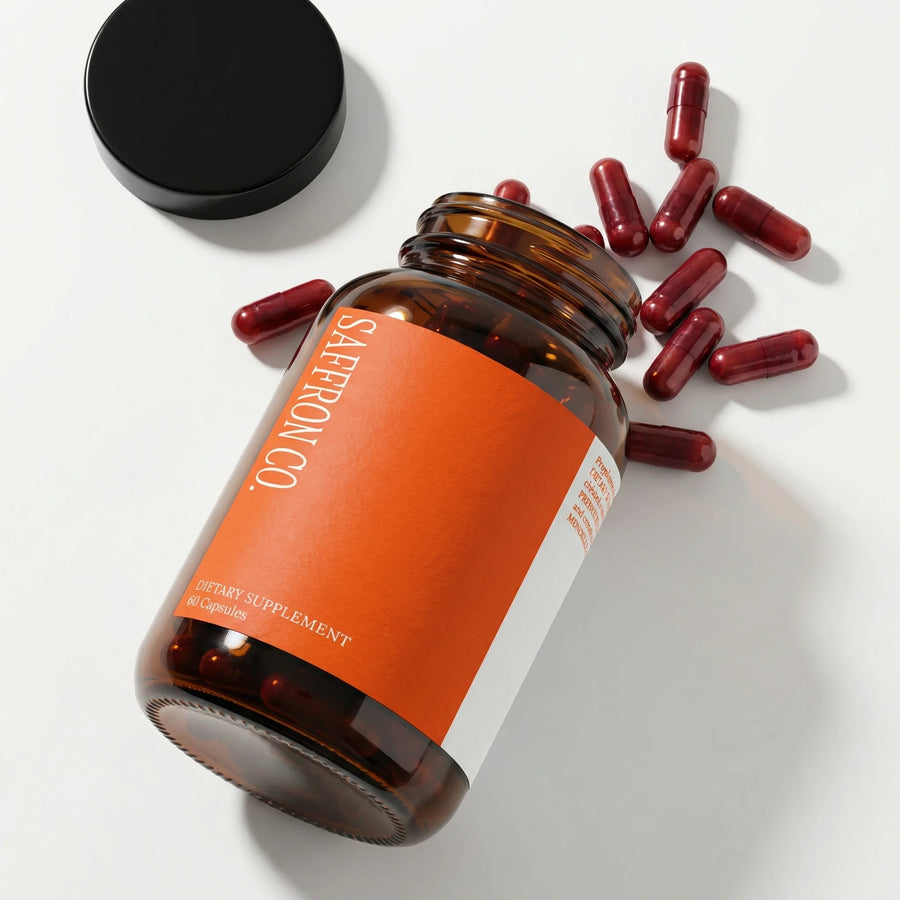
If saffron fits your pattern, the daily dose matters.
Saffron Co. delivers the studied 30 mg daily saffron dose standardized to ≥3.0% trans-crocin and ~1.2% safranal, paired with Rhodiola for stress adaptation, magnesium glycinate for nervous-system support, ProbioMood® NU-10 for the gut-brain axis, and active vitamin B6 (P5P).
Can you take saffron and L-theanine together?
In many cases, yes. They are often combined in multi-ingredient formulas because their roles can complement each other rather than compete.
That said, stacking should still be thoughtful. If you are already taking supplements for mood, stress, or sleep, or you use prescription medication for any condition, it is worth checking with your healthcare provider before adding another layer. This article is for informational purposes and is not medical advice.
Which One Works Faster, and What Results Can You Realistically Expect?
A lot of supplement disappointment comes from expecting the wrong thing on the wrong timeline.
How long saffron usually takes to work
Saffron is not an overnight ingredient. Most clinical research shows measurable effects after several weeks of daily use, typically 4 to 8 weeks. The dose used most often is around 30 mg per day.
Consistency matters. Taking it occasionally and hoping for a dramatic shift is usually not how saffron works.
How quickly L-theanine is usually felt
L-theanine is often noticed within 30 to 60 minutes, especially for calm focus or reduced mental tension.
But faster does not automatically mean stronger. It just means different. L-theanine is better for a quicker shift in state. Saffron is better suited to gradual support over time.
What neither ingredient can do. Neither saffron nor L-theanine should be framed as treating depression, anxiety disorders, ADHD, insomnia, or any other diagnosable condition. They may help support normal mood, stress response, focus, or relaxation, but that is not the same as treatment. They also cannot override deeper drivers such as chronic sleep debt, hormonal shifts, grief, burnout, or a clinical mental-health condition that needs professional care.
If you are taking prescription medication for mood, sleep, or any other condition, talk with your healthcare provider before adding a new supplement.
How to Choose Between Saffron and L-Theanine
The simplest way to choose is to match the ingredient to the job.
Choose saffron if your goal is baseline mood support
Choose saffron if you want support for emotional well-being, stress resilience over time, libido support, or feeling more like yourself again with consistent use.
On the label, look for a clinically aligned daily dose around 30 mg and a standardized saffron extract rather than a vague proprietary blend. That matters more than branding language.
Choose L-theanine if your goal is calm focus right now
Choose L-theanine if your main need is immediate calm, smoother focus, fewer caffeine jitters, or help settling mental overactivation.
It is often a simpler fit for situational use than for broader emotional flatness. If you know you mostly need quick calm rather than cumulative mood support, L-theanine is usually the cleaner choice.
When a multi-ingredient saffron formula may make sense
Some people do better with a fuller formula because mood, stress, focus, and nervous-system support often overlap in real life.
That is where a saffron-based formula like Saffron Co. Mood and Vitality Capsules may fit. It uses clinical-grade Spanish saffron at 30 mg per day, standardized to ≥3.0% trans-crocin and ~1.2% safranal, then adds supporting ingredients chosen for a specific reason: Rhodiola for stress adaptation, magnesium glycinate for nervous-system support, active B6 for neurotransmitter activation, and a probiotic for the gut-brain axis.
As a newer brand, Saffron Co. has less long-term independently published brand history than some established competitors. The 90-day money-back guarantee is how the brand handles that honestly. It lowers the risk for readers who like the formulation logic but do not want to gamble on a newer name.
The simple decision rule. If your dominant feeling is flat, dulled, or unlike yourself, start with saffron. If your dominant feeling is mentally noisy, jittery, or overstimulated, start with L-theanine. If both patterns travel together, a broader saffron-based stack that anchors on the studied dose with supporting ingredients is the cleaner third option. Give it 4 to 8 weeks before judging saffron. Give L-theanine an hour before judging that dose.
Buy a saffron-based formula if you want a broader stack rather than a single-ingredient quick-calm product. Consider a standalone L-theanine product instead if your main goal is situational calm focus and you do not need the wider mood-support formula.
Birthed by nature. Backed by science.
Try Saffron Co. for a full 4 to 8 week evaluation window, the timeline most saffron mood research uses. If you do not feel the difference, get your money back. No questions asked.
FAQ: Saffron vs L-Theanine
Is saffron better than L-theanine for anxiety?
For diagnosable anxiety, neither should be treated as a substitute for professional care. For general stress, tension, or emotional unease, L-theanine is often the better fit for quick calm, while saffron may be the better fit for broader mood support over time.
Can you take saffron and L-theanine together?
Often, yes. They are sometimes combined because saffron supports mood over time while L-theanine supports calm focus more quickly. But if you take prescription medication or other mood, sleep, or stress supplements, check with your healthcare provider first.
Does saffron or L-theanine work faster?
L-theanine usually works faster. Many people notice it within 30 to 60 minutes. Saffron is usually slower and more cumulative, with research most often showing benefits after 4 to 8 weeks of daily use.
Is L-theanine or saffron better for sleep?
L-theanine is usually the better fit for quieting mental chatter and winding down. Saffron is not primarily a sleep supplement, though some people may sleep better indirectly when mood and stress improve.
How long does saffron take to work for mood support?
Most saffron studies show measurable mood-support effects after 4 to 8 weeks of consistent daily use, typically at around 30 mg per day.
What should I look for in a saffron supplement?
Look for a saffron extract dosed around 30 mg per day and standardized clearly on the label, ideally with markers such as crocin or safranal content. Be cautious with proprietary blends that do not tell you the actual saffron dose.
This article is for informational purposes and is not medical advice. If you take prescription medication, are pregnant or nursing, or are managing a clinical condition, talk with a qualified healthcare provider before starting saffron, L-theanine, or any new supplement. These statements have not been evaluated by the Food and Drug Administration. These products are not intended to diagnose, treat, cure, or prevent any disease.