

Perimenopause is the transition leading up to menopause. Menopause is a single point 12 months after your last period. Here is what changes in each stage, the age and timing to expect, how to tell which one you are in, and what actually helps.
Perimenopause vs menopause: the simplest way to understand the difference
The clearest way to think about perimenopause vs menopause is this: perimenopause is the transition leading up to menopause, while menopause is the point you reach after 12 consecutive months without a period.
That distinction matters because many women use the word menopause to describe the whole experience, when technically it is one milestone, not a years-long phase. In real life, most of the changes people notice first, such as irregular periods, mood shifts, brain fog, hot flashes, or disrupted sleep, often begin during perimenopause.
After menopause comes postmenopause, which simply means the stage after that 12-month mark. It is part of the same overall life transition, but it helps to separate the phases so you know what is happening and what kind of support may make sense.
The one-line test: perimenopause is the transition, when hormones still fluctuate and periods are irregular. Menopause is the single point 12 months after your last period. Postmenopause is everything after that. Most symptoms people call "menopause" actually start in perimenopause.
See the stage-by-stage comparison →
What is perimenopause?
Perimenopause is the hormonally fluctuating transition phase before menopause. During this time, estrogen and progesterone do not decline in a smooth, predictable line. They rise and fall unevenly, which is why symptoms can feel inconsistent and why periods may become irregular.
For some women, perimenopause starts with subtle changes. Your cycle shortens. PMS feels more intense. Sleep gets lighter. You feel more emotionally reactive than usual. For others, the first thing they notice is hot flashes, heavier periods, or brain fog that seems to come out of nowhere.
What is menopause?
Menopause is confirmed retrospectively after 12 straight months without menstruation, assuming there is no other medical reason for the periods to have stopped. It is not something you usually know in the moment. You look back after a full year without a cycle and say, that last period was the one.
This is why the menopause conversation can feel confusing. It is a real biological transition, but the word itself refers to a specific point in time.
What is postmenopause?
Postmenopause is the stage after menopause. Some symptoms may ease over time, especially the more chaotic fluctuations that often define perimenopause. Others can continue, including hot flashes, sleep disruption, vaginal dryness, and lower libido.
It is also the stage when longer-term health factors deserve more attention, especially bone, heart, and vaginal health.
Perimenopause, menopause, and postmenopause at a glance
The three stages overlap in how they feel, but they differ in timing, periods, and the hormonal pattern underneath. This is the quickest way to see where you likely are.
| Perimenopause | Menopause | Postmenopause | |
|---|---|---|---|
| What it is | The transition before menopause, when hormones fluctuate | A single milestone: 12 months with no period | The ongoing stage after that milestone |
| Typical timing | Often the 40s, sometimes late 30s | Early 50s on average | After menopause, for the rest of life |
| Periods | Irregular: shorter, longer, heavier, or lighter | Have stopped for 12+ months | None |
| Hormones | Estrogen and progesterone rise and fall unevenly | Settled at a lower level | Low and relatively stable |
| Symptom pattern | Erratic and unpredictable | Can continue, often steadier | Some ease, some persist |
| Fertility | Pregnancy is still possible | Ends naturally | No longer fertile |
Perimenopause vs menopause symptoms: what tends to happen in each stage
When people search perimenopause vs menopause symptoms, they are usually trying to answer a practical question: what changes first, and what stage am I probably in?
The honest answer is that there is a lot of overlap. Both stages can involve hot flashes, night sweats, sleep disruption, mood changes, brain fog, low libido, and vaginal dryness. The main difference is often the pattern.
Perimenopause symptoms tend to feel more erratic because hormones are still fluctuating. Menopause and postmenopause can still be disruptive, but the hormonal picture is often less chaotic, even if certain symptoms continue.
Common perimenopause symptoms
Common perimenopause symptoms include:
- irregular periods
- cycles that are shorter or longer than usual
- heavier or lighter bleeding
- breast tenderness
- PMS-like mood shifts
- brain fog
- sleep changes
- increased stress reactivity
- hot flashes and night sweats
- lower libido
For many women, the irregular bleeding pattern is the first clue. For others, it is the emotional side. You may feel flatter, quicker to anger, more weepy, or just less like yourself than usual. That does not mean every mood change is caused by hormones, but hormones can absolutely shape how resilient or overwhelmed you feel.
Common menopause symptoms
Common menopause symptoms can include:
- ongoing hot flashes
- night sweats
- vaginal dryness
- sleep issues
- mood shifts
- lower libido
- brain fog
The key difference is that periods have already stopped. If you have gone 12 consecutive months without menstruation, that is the threshold that marks menopause.
Some women find symptoms settle once they are through the uncertainty of perimenopause. Others still deal with vasomotor symptoms, vaginal discomfort, or sleep disruption for years afterward.
Why symptoms can feel so unpredictable
The unpredictability is one of the hardest parts. In perimenopause, estrogen and progesterone fluctuate unevenly rather than declining neatly together. That means one month may feel manageable, while the next feels intense for no obvious reason.
You are not imagining that pattern. Hormonal shifts can affect temperature regulation, sleep quality, mood, concentration, and libido. Add normal life stress, work, caregiving, and sleep debt on top, and the whole picture can feel surprisingly disruptive.
When does perimenopause start, how long does it last, and when does menopause happen?
This is one of the biggest sources of confusion, partly because women are often given vague answers when they want concrete ones.
Perimenopause often starts in the 40s, but it can begin earlier. It may last several years before menopause is reached. Menopause itself usually happens in the early 50s on average, though individual timing varies.
Typical age ranges
A common timeline looks something like this:
- Late 30s to early 40s: early changes may begin for some women
- 40s: this is the most common window for perimenopause symptoms to become noticeable
- Early 50s: this is around the average age when menopause occurs
- Later 50s: some women reach menopause later than average
None of these ranges are hard rules. Earlier and later transitions happen. The goal is not to force yourself into an age box. It is to understand what is common so you do not feel blindsided.
How long each stage lasts
Perimenopause can last years. That is part of why it can feel so frustrating. It is not a quick switch.
Menopause is a one-day diagnostic milestone, defined retrospectively after 12 months without a period.
Postmenopause continues after that. It is the longer stage that follows.
Can you still get pregnant in perimenopause?
Yes. Pregnancy is still possible in perimenopause until menopause is confirmed.
Even if your cycles are irregular, ovulation can still happen. If pregnancy prevention matters to you, it is important not to assume irregular periods mean you can no longer conceive.
How to know whether it is perimenopause, menopause, or something else
It is reasonable to look for patterns, but it also helps not to self-diagnose too confidently from one symptom alone.
Age matters. Symptoms matter. But in everyday life, cycle history is often the clearest practical clue.
At the same time, thyroid issues, medication changes, chronic stress, sleep deprivation, and other health factors can overlap with perimenopausal symptoms. That is one reason the experience can be easy to misread.
Signs it may be perimenopause
It may be perimenopause if you are in your late 30s or 40s and notice:
- irregular cycles
- heavier or lighter periods
- hot flashes
- sleep disruption
- mood changes
- brain fog
- increased stress sensitivity
The combination matters more than any one symptom on its own.
Signs you may have reached menopause
You may have reached menopause if:
- you have gone 12 straight months without a period
- you are still dealing with hot flashes, night sweats, vaginal dryness, or lower libido
- there is no other clear medical explanation for the absence of menstruation
If you have had a hysterectomy or other medical factors that change bleeding patterns, the picture can be less straightforward and is worth discussing with a healthcare provider.
When to talk with a healthcare provider
It is worth checking in with a healthcare provider if you have very heavy bleeding, bleeding between periods, bleeding after menopause, significant pelvic pain, severe mood changes, symptoms that are disrupting daily life, or uncertainty about whether something hormonal or something else is going on.
Do not wait on these: very heavy bleeding, bleeding between periods, any bleeding after menopause, severe pelvic pain, or mood changes that interfere with daily life deserve prompt medical attention rather than self-management. If you take prescription medication for mood, sleep, or any other condition, talk with your provider before adding a supplement. This article is general information, not medical advice.
What can actually help during perimenopause and menopause
There is no single fix that makes this transition effortless. That is the frustrating part, but also the honest part.
What tends to help is a combination of basics, pattern awareness, medical support when appropriate, and selective use of supplements. Some women benefit from hormone therapy or other clinician-guided care. Others start with non-prescription support, especially when symptoms are milder or they want to begin with lifestyle changes.
Lifestyle support that matters more than people want to hear
The unglamorous basics often shape how manageable this transition feels:
- protecting sleep as much as possible
- strength training regularly
- eating enough protein
- watching how alcohol affects sleep, mood, and hot flashes
- being honest about caffeine if it worsens anxiety, palpitations, or sleep
- building in stress regulation practices that actually fit your life
- tracking symptoms over time
Symptom journaling is especially useful. It helps you see whether mood shifts, sleep issues, cycle changes, or hot flashes follow any pattern, and it gives you something concrete to bring to a medical appointment.
Where supplements may fit
Supplements may help support stress resilience, sleep quality, mood balance, and overall wellbeing, but they are not a cure-all.
A few evidence-aware options often discussed in this stage include:
- magnesium glycinate for nervous-system support and sleep quality
- saffron for mood support and emotional well-being
- adaptogens such as Rhodiola rosea for stress resilience
Results vary, and consistency matters more than jumping from one product to another every few days.
For women dealing with emotional flatness, stress sensitivity, low motivation, or the feeling that their mood and focus are no longer quite steady, a saffron-based formula can be worth considering. Saffron Co Mood and Vitality Capsules are one example built around clinical-grade Spanish saffron at the studied 30mg daily dose, supported by Rhodiola for stress adaptation, magnesium glycinate for nervous-system support, vitamin B6 in its active P5P form for neurotransmitter activation, and a probiotic for the gut-brain axis. The best fit is usually someone looking for mood support and stress resilience as part of a broader daily ritual, not someone looking for a substitute for medical treatment. The 90-day money-back guarantee also matters here because individual response to supplements genuinely varies.
If you want the stage-specific picture, the broader case for saffron for women and the detail on saffron for menopause are covered separately.
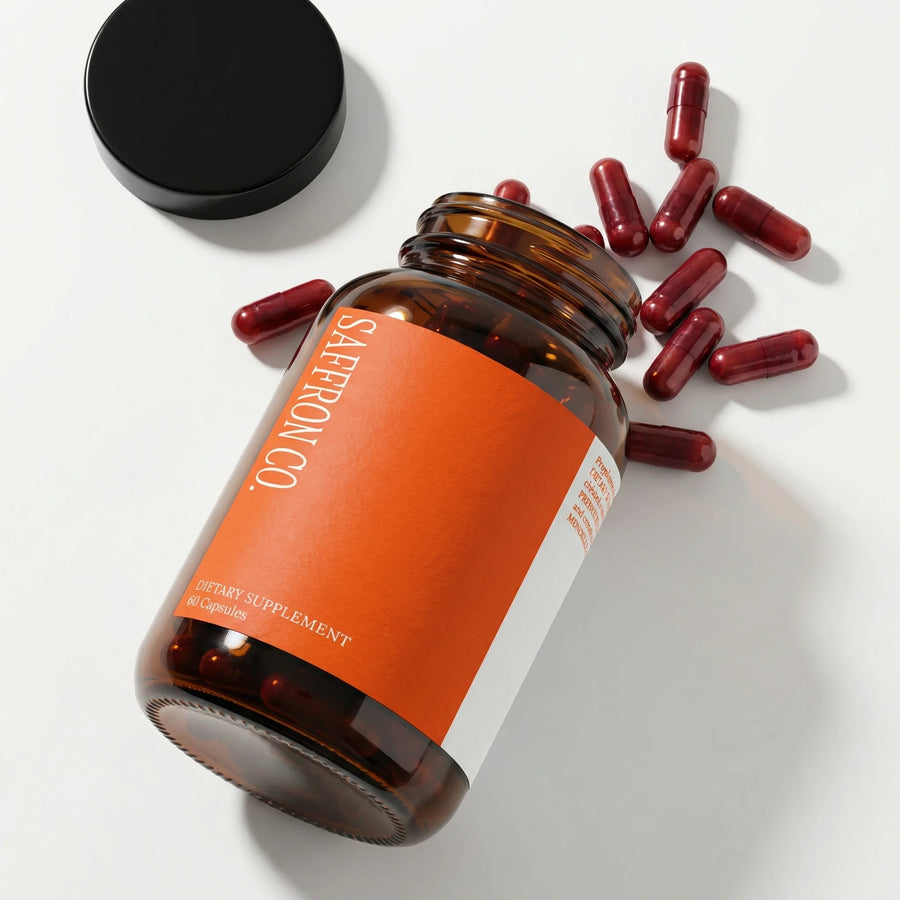
Daily support for the years in between.
Saffron Co. pairs the studied 30 mg daily saffron dose with Rhodiola for stress adaptation, magnesium glycinate for nervous-system support, ProbioMood® NU-10 for the gut-brain axis, and active vitamin B6 (P5P), for mood and stress support through the transition.
A realistic note on limits
Lifestyle tools and supplements may help support symptoms. They cannot diagnose your hormone status. They also cannot replace medical care for severe bleeding, major depression, significant pain, or other clinical concerns.
That limit is not a weakness. It is just the right frame. Midlife hormone changes are real, but they can overlap with other issues that deserve proper evaluation.
FAQ: perimenopause vs menopause
How do I know if I am in perimenopause or menopause?
The most practical clue is your cycle history. Perimenopause usually involves irregular periods plus symptoms like hot flashes, sleep disruption, mood shifts, or brain fog. Menopause is confirmed after 12 consecutive months without a period.
What are the first signs of perimenopause?
The first signs are often irregular cycles, changes in bleeding pattern, PMS-like mood shifts, lighter sleep, increased stress reactivity, or brain fog. For some women, hot flashes show up early too.
Perimenopause or menopause: which is worse?
Neither is universally worse. Perimenopause often feels more chaotic because hormones fluctuate unevenly, so symptoms can be unpredictable. Menopause and postmenopause may feel more stable, but symptoms like hot flashes, vaginal dryness, sleep issues, and lower libido can still be disruptive.
Can you still have symptoms after menopause?
Yes. Symptoms can continue after menopause, including hot flashes, sleep disruption, vaginal dryness, and lower libido. Postmenopause is not symptom-free for everyone, even if the hormonal swings of perimenopause have eased.
What supplements help with perimenopause symptoms?
Some women use magnesium glycinate for nervous-system support, saffron for mood support, and adaptogens for stress resilience. These may help support overall wellbeing, but results vary and they are not a replacement for medical care when symptoms are severe or bleeding patterns are concerning.
This article is for general information and is not medical advice. Supplements do not diagnose, treat, or cure perimenopause, menopause, or any hormonal condition, and they are not a substitute for menopause hormone therapy or clinician-guided care where those are needed. If you have concerning bleeding, severe symptoms, or are taking prescription medication or hormone therapy, or are pregnant or nursing, talk with a qualified healthcare provider. These statements have not been evaluated by the Food and Drug Administration. This product is not intended to diagnose, treat, cure, or prevent any disease.