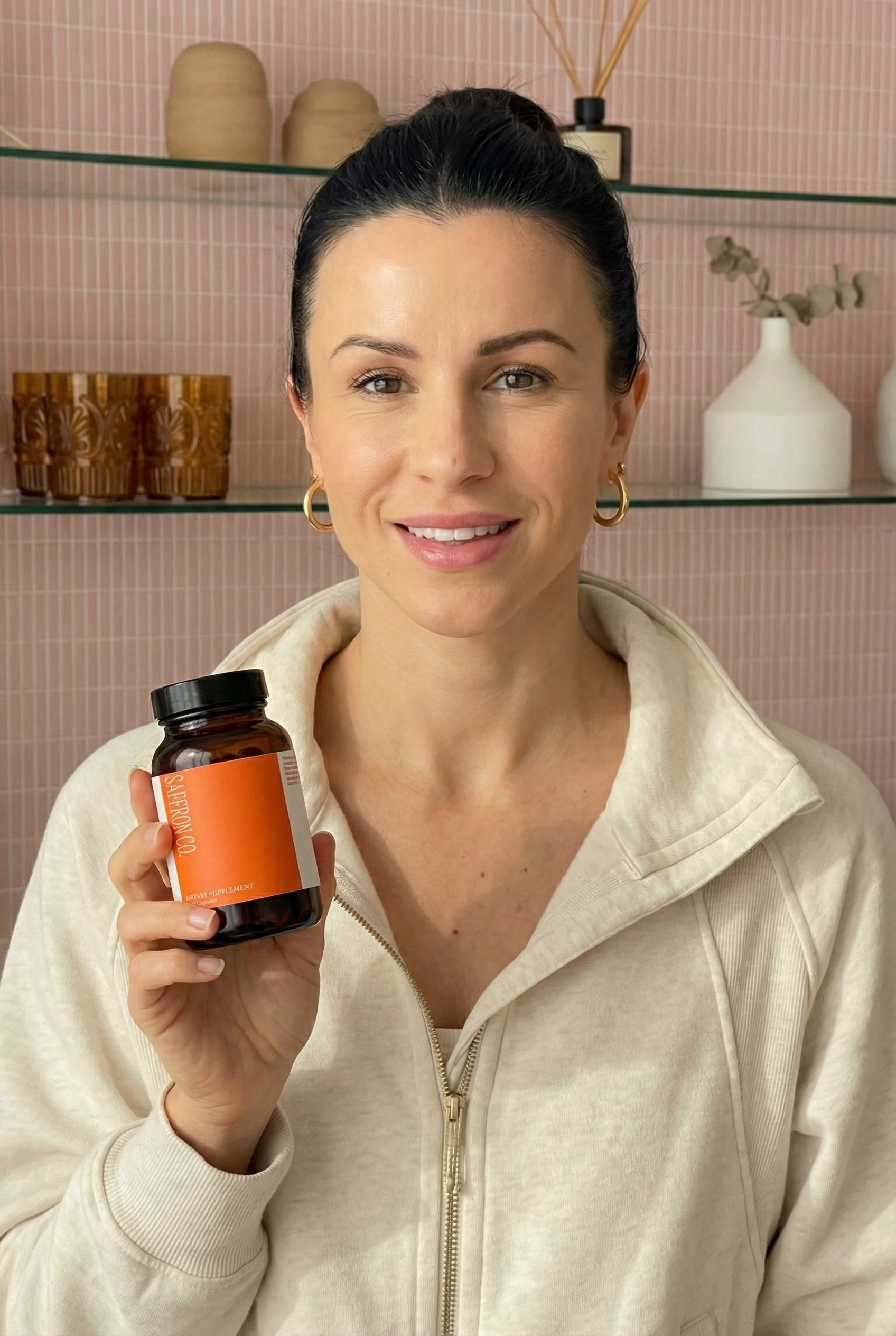

Perimenopause often shows up as feeling flatter, more reactive, foggier, and less like yourself. Here is what the research actually supports about saffron for mood, stress, sleep, and libido during this stage, where it fits, where it does not, and how to use it sensibly.
Why saffron for perimenopause is getting attention
Perimenopause does not always arrive as one obvious event. For many women, it shows up as a slow shift. You feel flatter than usual. More irritable. Less resilient. Sleep gets lighter. Your focus feels less dependable. You are still functioning, but you do not quite feel like yourself.
That is part of why saffron for perimenopause is getting so much attention. Women in midlife are often looking for support that feels gentler than an all-or-nothing approach. They want help with mood support, emotional well-being, stress resilience, sleep quality, and sometimes libido, without assuming every symptom needs the same solution.
Saffron has become interesting in this conversation because it has a meaningful body of clinical research behind it for mood support, especially at the 28 to 30 mg per day dose. That does not make it a cure. It is not hormone therapy. It does not replace clinical care when symptoms are severe. But it may be a useful part of the picture for women dealing with the emotional and cognitive side of perimenopause.
How this guide is organized: what perimenopause feels like, how saffron may work in the body, what the evidence supports symptom by symptom, how to take it and set expectations, and where it fits in a fuller plan. Saffron is one tool, not the whole answer, and the guide is built around that honesty.
See what the research supports →
What perimenopause can feel like day to day
Perimenopause often feels less dramatic than people expect and more disruptive than anyone warned you about.
Common patterns include:
- mood swings that seem out of proportion to what is happening
- brain fog and slower recall
- sleep disruption, especially waking in the night
- lower tolerance for stress
- feeling emotionally muted or unlike yourself
- less motivation or less interest in things that used to feel easy
- a drop in libido that feels tied to stress, exhaustion, or disconnection
These experiences are common, but that does not mean they are trivial. When they stack together, they can make daily life feel heavier than it should.
Where saffron may fit in a broader support plan
The most useful way to think about saffron is as one tool, not the whole answer.
For some women, that broader plan may include better sleep habits, more stable meals, regular movement, therapy, or nervous-system support. For others, it may also include a conversation about HRT or MHT with a clinician, especially if symptoms are clearly hormone-driven and affecting quality of life.
Saffron may fit best as a daily support tool for mood balance, emotional steadiness, and stress adaptation within that larger plan.
How saffron may work in the body during perimenopause
Saffron comes from the stigmas of Crocus sativus. Its best-studied compounds include crocin, crocetin, and safranal. These are the compounds most often discussed in research on mood and nervous-system effects.
At a high level, saffron is studied for how it may help support neurotransmitter activity involved in emotional well-being, especially serotonin and dopamine pathways. Research also points to antioxidant activity and possible support for brain-derived neurotrophic factor (BDNF), which is involved in neuronal health and plasticity, though the BDNF evidence is mainly preclinical.
That matters in perimenopause because fluctuating estrogen and progesterone can affect mood, sleep, stress response, and cognitive sharpness. Hormonal shifts can influence serotonin, GABA, and other signaling systems that help regulate how steady or reactive you feel. That does not mean saffron fixes the hormonal shift itself. It means some women are interested in non-hormonal support for the downstream effects of that shift.
Where saffron sits in the biology: its proposed mechanisms are on the neurotransmitter and stress-response side of perimenopause, not the hormone side. That is why saffron is better framed as support for how steady or reactive you feel than as anything that changes estrogen directly.
Does saffron increase estrogen?
There is not strong human evidence that saffron meaningfully raises estrogen levels. Its studied benefits are better framed around mood support, stress resilience, and emotional well-being than proven estrogen elevation.
Why the estrogen question comes up so often
The question makes sense. Many perimenopause symptoms are linked, directly or indirectly, to hormone fluctuation. So if a supplement seems helpful, it is natural to assume it must be increasing estrogen.
But supplements do not all work through the same route. Some are aimed at hormonal pathways. Others are better understood as nervous-system or mood support tools. Saffron fits more clearly into the second category based on the current evidence.
What the research says about saffron for perimenopause symptoms
The research picture is encouraging, but it needs careful framing.
Saffron has a stronger overall body of research for mood support than most people realize, with more than 24 peer-reviewed clinical studies across related use cases, most using a daily dose around 28 to 30 mg. The evidence specific to perimenopausal women is smaller, but it is emerging in a direction that makes saffron worth considering for the right symptoms.
The important distinction is this: the evidence is strongest for mood and emotional well-being, somewhat weaker for stress-related support and libido, and less consistent for sleep. It is not a leading tool for hot flashes or night sweats.
| Perimenopause concern | How strong is the saffron evidence | What that means in practice |
|---|---|---|
| Mood & emotional balance | Strongest | The best-studied use case. May help support mood balance and emotional well-being with consistent daily use at 28-30 mg. |
| Stress reactivity | Moderate | May help support a steadier response to everyday stress. Not a treatment for an anxiety disorder. |
| Libido & motivation | Moderate, nuanced | May help when low desire is tied to feeling flat, stressed, or disconnected. Less relevant when it is mainly hormonal or physical. |
| Sleep quality | Weaker, indirect | May help indirectly when poor sleep follows low mood or stress. Not a primary sleep aid, especially for night-sweat waking. |
| Brain fog & mental fatigue | Indirect | May ease the fog that travels with stress and low mood. Not a proven cognitive enhancer on its own. |
| Hot flashes & night sweats | Not a fit | Evidence is weak here. Hormone-based approaches or symptom-specific clinical care are usually more effective. |
Reading the table: saffron is a mood-first ingredient. It has the strongest case for the emotional and stress side of perimenopause, a real but nuanced case for libido, an indirect role in sleep and mental clarity, and little to offer for hot flashes and night sweats. Match it to the first group, not the last.
Mood, emotional balance, and stress reactivity
This is the best-supported use case.
Across clinical research, saffron has been studied for mood support and may help support emotional well-being with consistent daily use. The strongest interpretation is not that it transforms mood overnight, but that it may help smooth the emotional flatness, irritability, or low-grade heaviness that some women notice during perimenopause.
That matters because perimenopause mood changes are often not full clinical depression. They are more often described as feeling off, shorter-tempered, emotionally thinner, or less able to recover from stress. For this kind of subclinical but very real disruption, saffron is a reasonable ingredient to look at.
There is also interest in saffron's role in stress resilience. While saffron itself is not classically labeled an adaptogen, some women use it in formulas that pair it with ingredients aimed at stress adaptation. The fit here is not "cures anxiety." It is more modest and more believable: helps support emotional steadiness and a more resilient response to everyday stressors.
Sleep quality and mental fatigue
Sleep is where nuance matters.
Some discussions around saffron for perimenopause mention better sleep quality, easier evenings, or less mental fatigue. There is some reason for that interest, especially because poor sleep and low mood often travel together. But the evidence for saffron on sleep is not as strong or as consistent as it is for mood support.
For women whose sleep disruption is secondary to feeling wound up, emotionally taxed, or generally off-balance, saffron may have indirect value. But if the main problem is severe insomnia, frequent 3 a.m. waking, or sleep loss driven by hot flashes and night sweats, saffron is unlikely to be the most effective single tool.
Libido, motivation, and feeling like yourself again
This is a smaller but meaningful part of the conversation.
Some saffron research has explored libido support, and there is also a broader logic for why it comes up in perimenopause. When women feel emotionally flat, chronically stressed, or mentally overloaded, desire often drops with them. In that context, a supplement that supports mood balance and emotional well-being may also help support libido for some people.
The same goes for motivation. Many women do not describe themselves as depressed. They say they feel dulled out, disconnected, or less interested in life than they used to. Saffron may help support that "spark" side of the experience for some users, though this is still a more modest and variable effect than the internet often suggests.
What saffron is less likely to help
Saffron is not the strongest tool for vasomotor symptoms like hot flashes and night sweats.
Where a different approach usually wins: hot flashes, night sweats, heavy or disrupted bleeding, or physical symptoms that point to a broader gynecologic or endocrine issue. For those, hormone-based approaches or symptom-specific clinical care are generally more likely to help than any mood-support supplement.
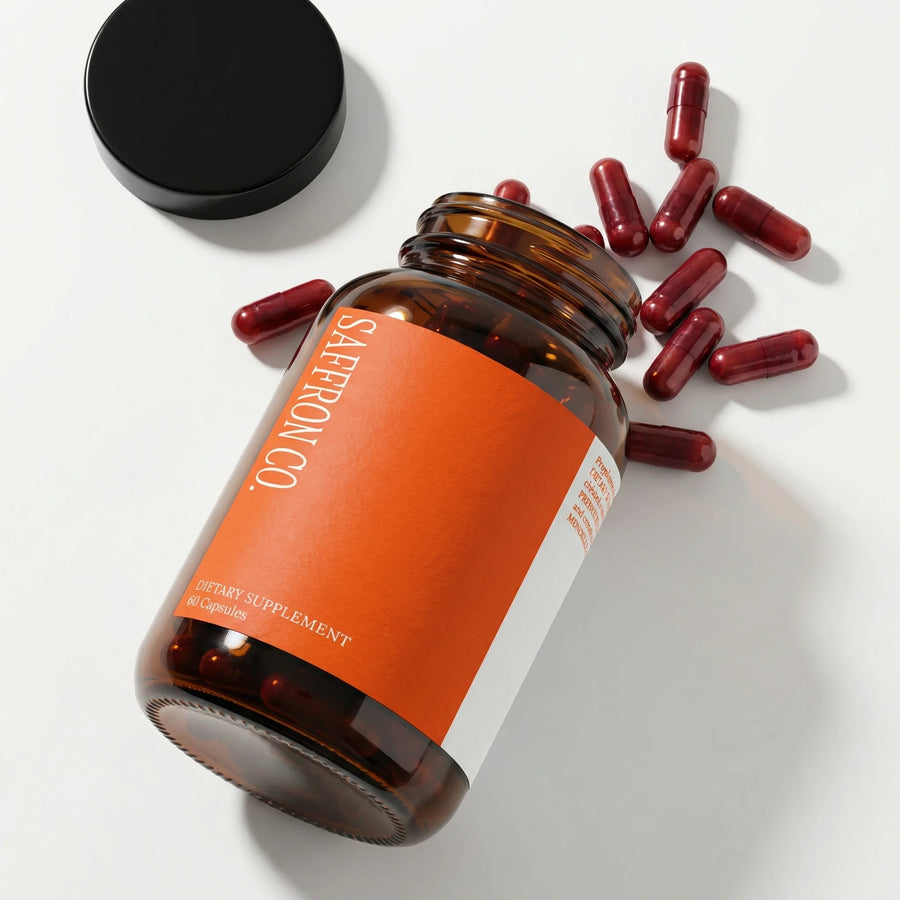
For the years when you feel less like yourself.
Saffron Co. pairs the studied 30 mg daily saffron dose with Rhodiola for stress adaptation, magnesium glycinate for nervous-system support, ProbioMood® NU-10 for the gut-brain axis, and active vitamin B6 (P5P), built around the way perimenopause symptoms actually travel together.
What saffron can and cannot realistically do in perimenopause
Saffron may help support mood balance, emotional steadiness, stress adaptation, and in some cases motivation or libido. That is the realistic upside.
It will not solve every perimenopause symptom. It will not rebalance the whole hormonal picture. It will not replace individualized care when symptoms are intense or persistent.
A reasonable fit may include women who are dealing with:
- emotional flatness
- mild low mood
- irritability or stress sensitivity
- brain fog alongside feeling mentally drained
- low libido connected to feeling off, overloaded, or disconnected
It is probably not enough on its own for severe insomnia, major depression, disabling anxiety, heavy bleeding, or strong hot flashes and night sweats.
If you are currently taking prescription medication for mood, anxiety, sleep, hormones, or any other ongoing condition, talk with your healthcare provider before adding a new supplement. The same applies if you are pregnant or nursing. This article is informational and not medical advice.
A good fit for the right problem
Saffron is generally better suited to the emotional and cognitive side of perimenopause than to structural hormonal or gynecologic issues.
That distinction matters. If your main complaint is "I do not feel like myself, I am more reactive, flatter, foggier, and less resilient than I used to be," saffron may be worth considering. If your main complaint is severe vasomotor symptoms, very disrupted sleep from night sweats, or menstrual changes that need medical evaluation, it is less likely to be the lead answer.
When MHT or professional care may be the more honest answer
For some women, the more honest answer is not another supplement. It is clinician-led care.
If symptoms are strongly hormone-driven and affecting your quality of life, a conversation about MHT or HRT may make more sense. If low mood has become persistent, severe, or functionally disruptive, therapy or medical support may be the right next step. These options are not in competition with supplements. They are simply different tools for different levels of need.
How to take saffron for menopause and perimenopause
Menopause and perimenopause are related but not identical. Perimenopause is the transition period leading up to menopause, when hormones fluctuate and symptoms often feel inconsistent. Menopause is the point reached after 12 consecutive months without a period. In practice, many women search for "how to take saffron for menopause" when they are still in perimenopause, because the symptoms overlap.
For both stages, the practical guidance is similar.
The most commonly studied saffron dose for mood support is around 28 to 30 mg per day. In the research, that dose is usually taken daily for several weeks. More is not necessarily better. The goal is consistency, not escalation.
Timing is flexible. Many people prefer taking saffron in the morning as part of a daily routine. In a multi-ingredient formula, timing may depend on what else is included.
How long saffron takes to work
This is not a fast-acting fix.
Many saffron studies run for 4 to 8 weeks, and that is the most honest expectation to set. Some people notice subtle shifts earlier, but the research generally supports saffron as a steady daily ritual rather than something you feel dramatically in a few days.
If you are trying saffron, give it enough time to judge it fairly.
What to look for in a saffron supplement
Not all saffron supplements are equal. A better-quality product should have a clinical-range dose of around 28 to 30 mg per day, a standardized extract rather than generic saffron powder, transparent labeling that shows what is actually in the capsule, a clear reason for any additional ingredients, and no vague proprietary blend hiding underdosing.
The label checklist, in one line: a named saffron dose near 28-30 mg per day, visible standardization markers (trans-crocin and safranal), third-party testing, supporting ingredients with a stated job, and a guarantee window long enough to cover the 4-8 week evaluation the research actually uses.
If a brand does not tell you the dose clearly or whether the extract is standardized, that is usually not a good sign.
When a fuller formula may make sense
Some women want single-ingredient saffron. Others want broader support in one capsule.
A fuller formula may make sense when the goal is not just mood support in isolation, but also support for stress adaptation, nervous-system function, neurotransmitter pathways, or the gut-brain axis. In perimenopause, that broader logic can be useful because symptoms rarely show up one at a time.
Saffron side effects, safety, and medication questions
Saffron is generally well tolerated in studied amounts, especially around the clinical 28 to 30 mg range. But "well tolerated" does not mean identical for everyone.
Possible mild side effects can include:
- digestive upset
- headache
- dizziness
- nausea
- individual sensitivity
These effects are usually not severe, but they are still worth acknowledging honestly.
Can you take saffron every day?
Yes. Daily use is how saffron is typically studied.
Consistency matters more than taking more. The clinical research does not suggest that pushing the dose higher improves outcomes. A steady daily intake at the studied range is the better model.
Can saffron be taken with antidepressants or HRT?
This is a question for a qualified healthcare provider, not something to self-decide casually.
If you are using prescription medication for mood, anxiety, sleep, hormones, blood pressure, or any other ongoing condition, speak with your clinician before adding saffron. The same caution applies to HRT or MHT. Saffron has a better interaction profile than some other mood-related botanicals, but that is not the same as saying interactions are impossible or irrelevant.
Who should be more cautious
Extra caution makes sense for:
- anyone who is pregnant or nursing
- anyone taking prescription medications
- anyone with bipolar-spectrum concerns
- anyone with significant or worsening mood symptoms
- anyone with symptoms severe enough to interfere with daily functioning
If your symptoms are escalating rather than gradually improving, that is a strong signal to get medical support rather than trying to supplement your way through it.
Where a high-quality saffron supplement may fit
Once the educational groundwork is clear, the next question becomes practical: what kind of saffron supplement is actually worth considering for this use case?
For perimenopause-related mood and stress support, the best fit is usually a product with a clinical-range saffron dose, strong standardization, and formulation logic that matches what you are actually trying to support.
Some women will prefer a simple single-ingredient saffron extract. That can make sense if you want the cleanest possible trial. Others may prefer a broader formula because perimenopause rarely feels like one isolated symptom.
Who a saffron-based daily formula may suit best
A saffron-based daily formula may suit women in their 30s to 60s who feel flat, stressed, emotionally off, foggy, or disconnected and want non-hormonal daily support with consistent use.
That is especially true when the goal is broader emotional support, not just trying one isolated ingredient in a vacuum.
What separates Saffron Co from a basic saffron capsule
If that broader approach appeals to you, Saffron Co Mood and Vitality Capsules are worth considering for a specific reason: the formulation logic.
The formula uses Spanish saffron extract at 30 mg per day, standardized to at least 3.0% trans-crocin and about 1.2% safranal, which aligns with the clinically studied dose range. Then it adds four supporting ingredients that serve a defined role: Rhodiola rosea for stress adaptation, magnesium glycinate for nervous-system support, vitamin B6 in its active P5P form for neurotransmitter activation, and a probiotic to support the gut-brain axis.
That makes it a different proposition from a basic saffron capsule. It is built for women who want a more complete daily stack rather than saffron alone.
It is also worth noting that Saffron Co is a newer brand, which means it has less long-term market history than some more established competitors. The brand answers that honestly with a 90-day money-back guarantee, which matters when response to any supplement can vary from person to person. If you want to review the formulation itself, the brand's formula explanation page is the clearest place to start, and the product page has the full label, pricing, and guarantee details.
Buy if this fits, consider other options if it does not
Buy Saffron Co if you want a clinical-range saffron formula with broader support for stress, nervous-system function, neurotransmitter pathways, and the gut-brain axis, and if the 90-day guarantee fits how you prefer to try new products.
Consider a simpler single-ingredient saffron option instead if you want the cleanest possible self-test, or if you prefer an established brand with a longer market track record. There is no single best answer here. The best option is the one that fits the problem you are actually trying to solve.
Birthed by nature. Backed by science.
Try Saffron Co. for a full 4 to 8 week evaluation window, the timeline the saffron research actually uses. If you do not feel the difference, get your money back. No questions asked.
FAQ: saffron for perimenopause
Does saffron help perimenopause mood swings?
It may help support mood balance and emotional well-being, especially when perimenopause shows up as irritability, flatness, or lower stress tolerance. This is the best-supported use case for saffron. It is not a treatment for a diagnosable mood disorder, but it may be a useful daily support tool for milder emotional disruption.
Does saffron increase estrogen?
There is not strong human evidence that saffron meaningfully increases estrogen. The better-supported explanation is that saffron is studied for mood support, emotional well-being, and stress resilience rather than direct estrogen elevation.
How long does saffron take to work for perimenopause?
Most research runs for 4 to 8 weeks, so saffron is best understood as a consistent daily ritual rather than a quick fix. Some people notice subtle changes earlier, but the strongest evidence supports giving it several weeks.
What is the best dose of saffron for perimenopause?
The most commonly studied dose for mood support is about 28 to 30 mg per day of a standardized saffron extract. That is the range most worth looking for on a label.
What are the most common saffron side effects?
Saffron is generally well tolerated, but mild side effects can include digestive upset, headache, dizziness, nausea, or individual sensitivity. If symptoms feel significant or unusual, stop use and speak with a healthcare provider.
Can you take saffron with antidepressants or HRT?
Anyone taking antidepressants, mood medication, sleep medication, HRT, or other prescription treatments should speak with a qualified healthcare provider before adding saffron. That is the safest and most appropriate route.
This article is for informational purposes and is not medical advice. Saffron supplements do not treat perimenopause, menopause, or any hormonal condition, and they are not a substitute for menopause hormone therapy or clinician-guided care where those are needed. If you take prescription medication or hormone therapy, are pregnant or nursing, or are managing a clinical condition, talk with a qualified healthcare provider before starting a new supplement. These statements have not been evaluated by the Food and Drug Administration. This product is not intended to diagnose, treat, cure, or prevent any disease.