
Rhodiola vs ashwagandha: how to pick by your stress pattern
Rhodiola rosea is the daytime adaptogen for stress that shows up as fatigue and fog. Ashwagandha is the evening one for stress that shows up as tension and a nervous system that will not downshift. Picking between them is a question about your own pattern, not about which herb has the better reputation.
Both herbs are adaptogens, plants studied for helping the body hold steadier function under stress. Rhodiola rosea is the more activating of the two and is standardized to rosavins and salidroside. Ashwagandha is the more sedating one and is standardized to withanolides. Most of the confusion between them comes from treating stress as one condition when the two herbs answer two different versions of it.
One version is depletion: flat, foggy, no drive, running on empty by two in the afternoon. The other is agitation: keyed up, jaw tight, still awake at eleven with a body that will not switch off. Rhodiola suits the first. Ashwagandha suits the second. Take the wrong one and you either add stimulation you did not need or flatten yourself further.
Rhodiola vs ashwagandha at a glance
Pick by the shape of your stress rather than by the herb with the louder marketing.
| What you are dealing with | Better fit | Why |
|---|---|---|
| Stress-related fatigue and brain fog | Rhodiola | Studied for fatigue under prolonged stress without sedation |
| Feeling wired, tense, unable to unwind | Ashwagandha | Associated with lower perceived stress and cortisol |
| Daytime focus and mental stamina | Rhodiola | Trialed in people with burnout symptoms, open-label |
| Trouble falling asleep after a stressful day | Ashwagandha | Sedating profile suits the wind-down window |
| Thyroid condition, autoimmune disease, pregnancy | Neither without a clinician | Ashwagandha carries specific thyroid and pregnancy cautions |
The short version: if you feel drained, start with rhodiola. If you feel wired, start with ashwagandha. If you feel both at different hours of the same day, which is the common pattern in your thirties and forties, start with the one matching your worst hour rather than taking both.
What rhodiola and ashwagandha actually do
Both herbs act on the stress response, and they act on different ends of it. Rhodiola is studied mainly for stress-related fatigue and mental performance. Ashwagandha is studied mainly for perceived stress, tension and sleep quality.
Standardization decides how much of that research applies to the bottle in your hand. Two products can say rhodiola on the front and deliver very different extracts underneath, so the percentage on the panel matters more than the herb name on the label.
How rhodiola works
Rhodiola rosea supports the stress response without sedating you, which is why it is taken in the morning. It acts on the hypothalamic-pituitary-adrenal axis, the feedback loop that governs cortisol release, and the research clusters around stamina rather than calm.
Rosavins and salidroside are the two markers worth reading on a label. The trial-grade extracts are standardized to roughly 3 percent rosavins and 1 percent salidroside, and that ratio is what the fatigue and burnout studies used. A bottle listing only milligrams of powdered root tells you nothing about either compound.
How ashwagandha works
Ashwagandha calms rather than activates. Withanolides are its marker compounds, and the stress trials most often cited used 300 mg twice daily of a root extract, measuring perceived stress and cortisol over 60 days.
Root-only and root-plus-leaf extracts behave differently, and withanolide percentages vary widely between brands. That variability explains why one person calls ashwagandha life-changing and the next says it made them feel heavy and blunted.
Why they feel so different
Rhodiola tends to feel like the fog lifting. Ashwagandha tends to feel like the volume coming down. If you are already overstimulated, rhodiola can tip you into jittery. If you are already flat, ashwagandha can flatten you further.
Dose, timing and your starting state drive the experience more than the herb's reputation does. Somebody who takes ashwagandha at 8 a.m. and feels foggy by noon has not found a bad herb, just a badly timed one.
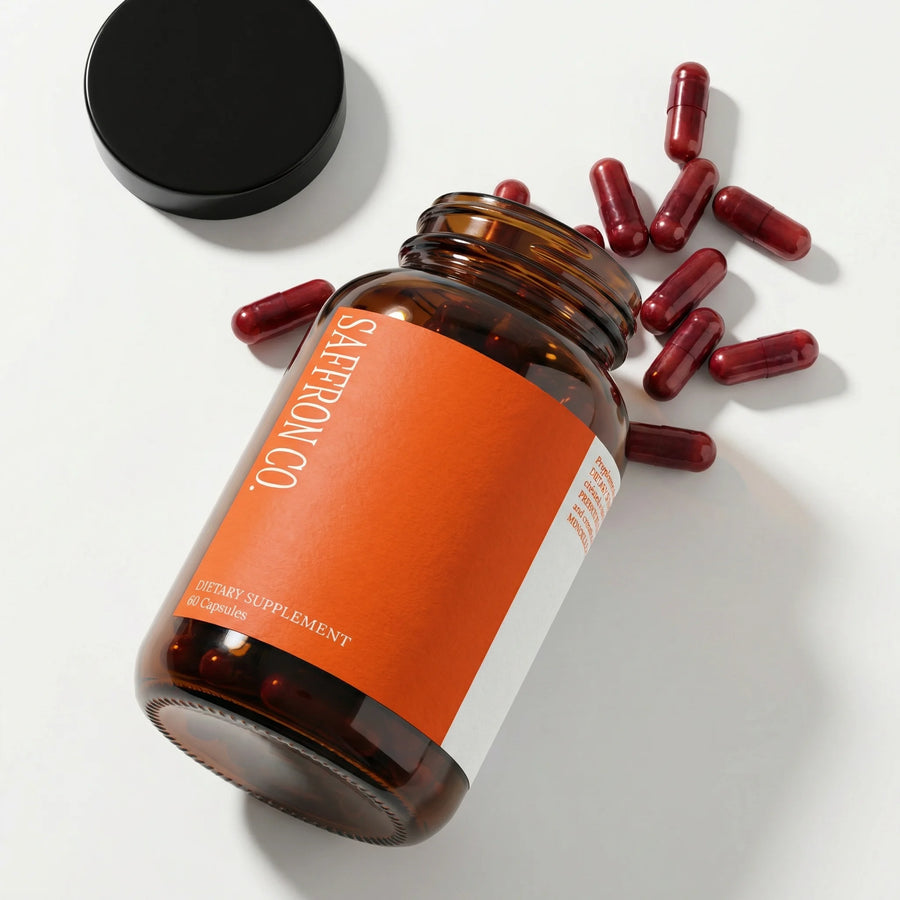
Rhodiola, at the standardized dose, in a daily formula.
Saffron Co pairs Rhodiola root extract standardized to 3 percent rosavins and 1 percent salidrosides with the clinically studied 30 mg saffron dose, magnesium glycinate, active B6 and a probiotic. Structure-function support for mood, stress and sleep, not a treatment for any condition.
Plans: $59.90/mo 30-day auto-ship · $119.92 90-day auto-ship (best value) · $69.90 one-time. 90-day money-back guarantee.
See What's InsideRhodiola vs ashwagandha for cortisol, energy, focus, and sleep
The comparison only becomes useful once you split it by symptom. Below, each goal gets the herb the evidence points at and the honest limit that goes with it.
For cortisol
Ashwagandha is the one with cortisol data attached. A 60-day trial of 300 mg twice daily reported reductions in serum cortisol and perceived stress against placebo. Rhodiola research measures fatigue and performance instead.
Cortisol is also a poor shopping criterion. A single morning reading tells you very little, and a supplement that leaves your cortisol curve alone while you feel steadier through the afternoon has done the job you wanted. Buy for the symptom, not the biomarker.
For energy and burnout
Rhodiola is the better fit when stress has left you depleted rather than agitated. A 12-week multicenter trial gave rhodiola extract to 118 people with burnout symptoms and tracked exhaustion and daytime functioning rather than relaxation. It was open-label with no placebo arm, so read it as supportive rather than conclusive.
Ashwagandha can help the exhaustion that comes from being permanently clenched, though for someone already flat it often deepens the flatness. Neither herb touches the causes: a 60-hour week, a toddler, a perimenopausal sleep pattern or a sleep debt built over months.
For focus and brain fog
Rhodiola again. Its studies measured mental fatigue under load, the kind that turns a 20-minute task into an hour at 3 p.m.
Ashwagandha supports concentration indirectly, by lowering the noise, and that is a slower and less reliable route to a sharp afternoon. Nobody takes ashwagandha at lunchtime to finish a spreadsheet.
For sleep
Ashwagandha is the adaptogen with sleep evidence, and rhodiola in the evening is a common self-inflicted mistake. If your nights are the problem, rhodiola is not the herb, and taking it after 2 p.m. can make things worse for sensitive people.
Ashwagandha is not the only non-prescription route to a calmer night. Saffron has its own placebo-controlled sleep data, and magnesium glycinate supports normal muscle and nerve function without sedation, which is the combination we built around. Our guide to saffron for sleep covers what those trials measured and over what timeframe, and saffron vs ashwagandha compares the two head to head.
Why our formula uses rhodiola and not ashwagandha: ashwagandha sedates, and it carries thyroid and pregnancy cautions that matter to a lot of women in their forties. Rhodiola at 100 mg standardized to 3 percent rosavins covers the daytime half of stress, and the saffron and magnesium glycinate in the same capsule cover the evening half without adding sedation. If your stress is purely a wired-at-night problem and nothing else, a standalone ashwagandha is the more direct answer, and we would rather say so.
For weight loss
Neither herb causes fat loss. Any effect is secondhand, through sleeping better or feeling steady enough to keep habits going, and that is a long way from what weight-loss marketing implies.
A product leaning hard on adaptogens for weight loss is telling you what it cannot prove.
How to choose in real life
Match the herb to how you feel at 2 p.m. and at 10 p.m. Those two moments settle the decision faster than any ingredient comparison.
Start with rhodiola if
- your afternoons are fog and low drive rather than tension
- you need to function through the stress, not sleep through it
- you want movement inside the first week or two, which is where the rhodiola burnout trial saw its earliest changes
- you take supplements in the morning and would forget an evening dose
- sedating herbs have left you flat or foggy before
Start with ashwagandha if
- your stress peaks at night and keeps you from falling asleep
- you feel physically tense and reactive rather than empty
- you can give it several weeks, since its trials run 30 to 60 days
- you have no thyroid condition, autoimmune diagnosis or pregnancy to account for
- daytime stimulation of any kind makes you feel worse
Can you take rhodiola and ashwagandha together?
You can, and starting both on the same day is how people end up unable to tell which one did anything. Run one for two to three weeks, judge it, then decide whether the second is worth adding.
If you do combine them, rhodiola belongs in the morning and ashwagandha in the evening, which follows their profiles rather than fighting them. Single-ingredient products make this easier to control than one blend that fixes the ratio for you.
Anyone taking prescription medication, and anyone with a thyroid condition, an autoimmune diagnosis or a pregnancy, should clear either herb with a clinician first. This article is informational and is not medical advice.
What to look for on the label
Ignore the front of the bottle and read the panel for these:
- rhodiola standardized to about 3 percent rosavins and 1 percent salidroside, the ratio used in the trials
- ashwagandha with a stated withanolide percentage and whether it is root-only or root-and-leaf
- a dose in milligrams of extract, not of raw powdered root, which is a weaker input
- third-party testing, ideally through an ISO-accredited lab rather than an in-house claim
- no proprietary blend, which hides how little of each ingredient is actually present
Side effects, interactions, and honest expectations
Rhodiola can overstimulate. Jitteriness, restlessness and a wired edge are the usual complaints, almost always from too high a dose or too late a dose.
Ashwagandha causes drowsiness and stomach upset in some people, and it carries genuine cautions around thyroid function, autoimmune conditions and pregnancy. It is the more consequential of the two to add casually.
Neither herb treats a clinical anxiety disorder, resolves burnout, or replaces care for a mood or sleep problem that has been building for months. If symptoms are severe, persistent or getting worse, that is a clinician's job rather than a supplement's.

Saffron Co Mood & Vitality Capsules
Best for the reader whose stress runs both ways: foggy by afternoon, restless by night, and who would rather not take a sedating herb to fix the second half. Two capsules carry 100 mg of Rhodiola standardized to 3 percent rosavins, 30 mg of standardized Spanish saffron, 140 mg of magnesium as glycinate, active B6 and a probiotic. It contains no ashwagandha, so if a sedating adaptogen is specifically what you want, this is not that product.
The reasoning behind each ingredient, including why rhodiola made the panel and ashwagandha did not, is set out in why this formula. For stress specifically, saffron for stress covers what the saffron trials measured.
Birthed by nature. Backed by science.
Give it the several weeks the saffron and adaptogen research uses. If your stress, mood and sleep do not feel steadier, get your money back, no questions asked.
Plans: $59.90/mo 30-day auto-ship · $119.92 90-day auto-ship (best value) · $69.90 one-time. 90-day money-back guarantee.
Try Saffron Co Risk-FreeCommon questions
Is rhodiola or ashwagandha better for cortisol?
Ashwagandha is the one with direct cortisol evidence. A 60-day placebo-controlled trial using 300 mg twice daily reported lower serum cortisol and lower perceived stress. Rhodiola research measures fatigue, stamina and mental performance rather than cortisol, so it can leave your cortisol curve unchanged while still making stressful days more manageable. Choose by the symptom you actually have rather than by a cortisol claim on a label.
Can you take rhodiola and ashwagandha together?
You can, but adding both at once makes it impossible to tell which one is working. Start one, give it two to three weeks, then decide whether the other is worth adding. If you run both, take rhodiola in the morning because it is activating and ashwagandha in the evening because it is sedating. Check with a clinician first if you take prescription medication or have a thyroid or autoimmune condition.
Which works faster, rhodiola or ashwagandha?
Rhodiola is the faster of the two. In the 12-week burnout trial, several stress and exhaustion measures had already improved after one week of 400 mg a day. Ashwagandha is cumulative, and its main trials ran 30 to 60 days before measuring outcomes, so judging it after a week is judging it too early.
Is rhodiola or ashwagandha better for weight loss?
Neither is a weight-loss supplement. Any effect on body weight would be indirect, arriving through better sleep, steadier energy or lower stress making healthy habits easier to keep. No adaptogen causes meaningful fat loss on its own, and marketing that suggests otherwise is running ahead of the evidence.
What is the best time of day to take rhodiola or ashwagandha?
Take rhodiola in the morning, ideally before noon, because its activating profile can interfere with sleep when taken late. Take ashwagandha in the late afternoon or evening if calm or sleep support is the goal. Reversing the two is the most common dosing mistake with these herbs, and it usually produces the opposite of the intended effect.
This article is for informational purposes only and is not medical advice. Rhodiola, ashwagandha, saffron and the other ingredients discussed are supportive, structure-function ingredients; they do not diagnose, treat, or cure anxiety, insomnia, burnout, or any condition, and are not a substitute for clinician-guided care. If your symptoms are severe, persistent, or escalating, or you take prescription medication, have a thyroid or autoimmune condition, or are pregnant or nursing, talk with a qualified healthcare provider before starting a new supplement. These statements have not been evaluated by the Food and Drug Administration. This product is not intended to diagnose, treat, cure, or prevent any disease.