Gradual sleep support, not a knockout pill
Randomized trials tested saffron on sleep directly, at 28 to 30 mg, where Saffron Co's 30 mg sits. Gentle daily support, not a sedative.
See the FormulaSaffron is not a sedative and not a fix for insomnia. But it has randomized, placebo-controlled trials that measured sleep directly, at doses of 28 to 30 mg, right where Saffron Co's 30 mg sits. Here is what those trials actually found, who saffron fits, when to take it, and how it compares to melatonin and prescription sleep aids.
What is saffron for sleep, and can it actually help?
A lot of sleep problems do not look dramatic from the outside. You go to bed at a reasonable hour. You may even fall asleep. But the sleep feels light, restless, or strangely unrefreshing. Or your body is tired and your mind is still running. For many women, especially in the 35 to 65 range, that pattern shows up alongside stress, emotional flatness, brain fog, or hormonal shifts that make nights feel less predictable than they used to.
So, can saffron actually help with sleep? The honest answer is yes, possibly, but within limits. Saffron has emerging clinical research suggesting it may help support sleep quality and reduce certain sleep complaints in some adults. It is not a sedative, and it is not a cure for chronic sleep disorders.
The distinction that matters: supporting sleep quality is not the same as treating insomnia. Easing stress-related sleep disruption is not the same as addressing sleep apnea, major hormonal disruption, or medication-driven sleep problems. Saffron fits best as a gentle, daily support option for people whose sleep is being affected by the wider mood, stress, and nervous-system picture, not as a rescue pill for a serious sleep disorder.
See how it compares to melatonin →
For the nights your mind won't switch off.
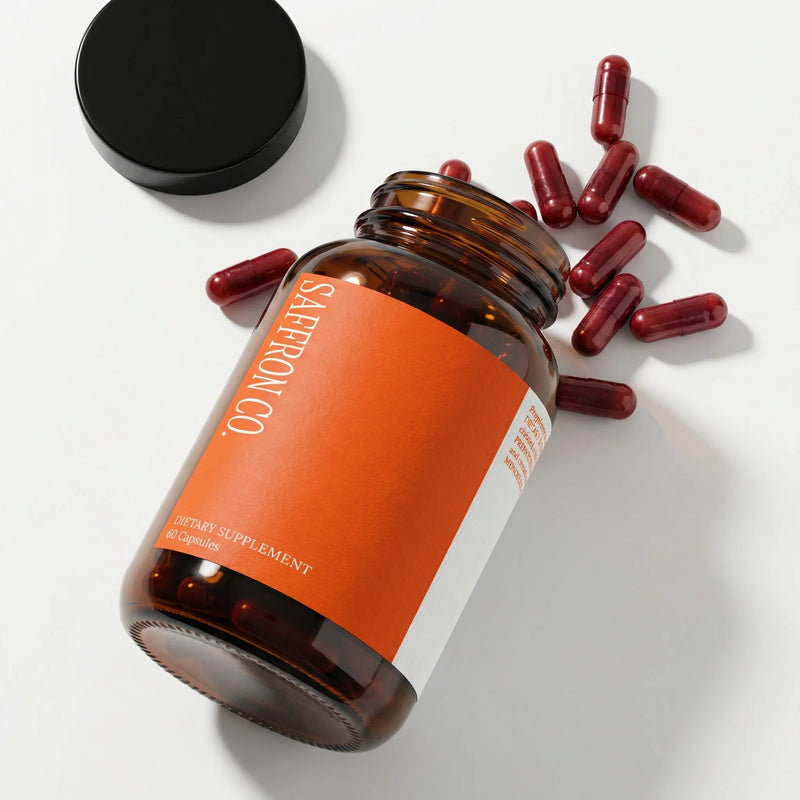
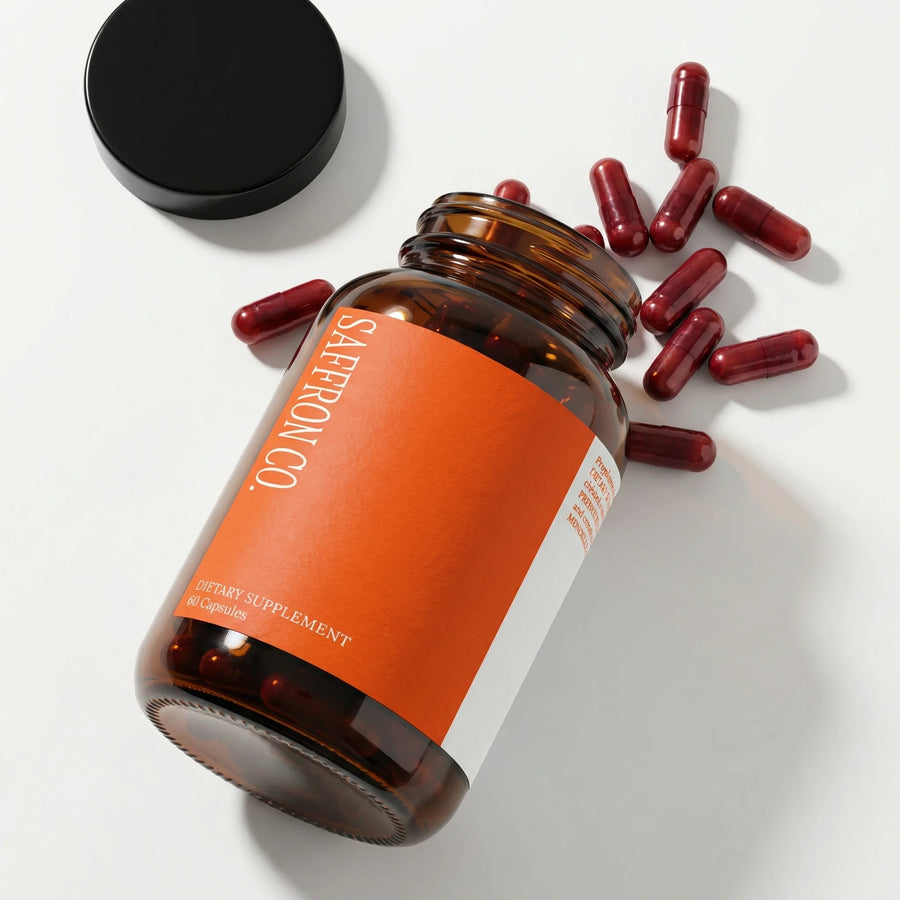
Saffron Co pairs the studied 30 mg saffron dose with Rhodiola, magnesium glycinate, and active vitamin B6 (P5P), daily support for the mood, stress, and nervous-system steadiness that better sleep depends on. Not a sedative, and not a treatment for insomnia.
A quick answer: what saffron may help support
Saffron may help support sleep quality, easier sleep onset, and a calmer next-day feel in some adults. This is not just mood-adjacent evidence: randomized trials have tested saffron on sleep directly and measured better sleep-quality and insomnia-severity scores versus placebo. The effect is gentle rather than a knockout, but it is a front-door sleep finding, not a sideways one.
Why people are looking at saffron for sleep
Part of the appeal is simple. Many people want sleep support that does not feel heavy, habit-forming, or next-day dulling. That is especially true for women who feel wired at night, flat during the day, or generally out of sync in perimenopause or menopause. A saffron supplement can be appealing because it is better understood as a daily ritual than a rescue pill. Instead of forcing sleep in the moment, it may help support the mood, stress response, and nervous-system steadiness that better sleep depends on.
How saffron may support sleep quality
Saffron is most often discussed for mood support, but sleep is closely tied to the same biology. Research suggests saffron's active compounds, including crocin and safranal, may influence serotonin and dopamine pathways, support healthy stress-response patterns, and provide antioxidant activity that may help protect nerve cells. That does not make saffron a sleeping pill. It makes it a whole-system support ingredient.
Sleep quality is shaped by more than bedtime alone. It reflects mood, nervous-system state, stress reactivity, and daily stimulation. That broader lens is why saffron, and a couple of well-chosen supporting ingredients like magnesium, can make sense for people whose sleep issues do not exist in isolation.
Saffron, stress, and the nervous system
Many sleep complaints are really stress complaints wearing a sleep mask. You lie down, but your body does not shift fully into rest. Your thoughts stay busy. Small stressors feel larger at night. You wake too easily, or you sleep but do not feel restored.
Saffron may help indirectly here by supporting emotional well-being and stress resilience. Some research suggests it may help modulate neurotransmitters involved in mood and nervous-system balance. If stress reactivity is part of why sleep feels fragile, saffron may support the conditions that make better rest more likely over time. This is also why saffron often makes more sense for the person who says "I cannot switch off" than for the person looking for immediate sedation.
Magnesium, the other sleep-relevant ingredient
Saffron is the headline, but it is not the only sleep-relevant part of a well-built formula. Magnesium has its own research for sleep, particularly in people who are low in it to begin with, and it supports the muscle relaxation and nervous-system calm that make winding down easier. The glycinate form is generally well absorbed and a sensible choice for evening use, which is why a saffron formula that also includes magnesium can be more relevant for sleep than saffron alone.
The gut interacts with sleep through the nervous system too, so broader formula design can matter, but for a sleep goal specifically, saffron and magnesium are the parts with the most to stand on.
Why saffron is different from melatonin and stronger sleep aids
Melatonin and saffron are not doing the same job. Melatonin is mainly about circadian timing, useful when the issue is jet lag, shift work, or a delayed sleep schedule. Saffron is better framed as broader mood-stress-sleep support. Prescription sleep medications are a different category again, used under medical care for clinical insomnia or more severe disruption. Saffron should not be presented as an alternative to that level of care.
| Approach | How it works | Best for |
|---|---|---|
| Saffron (~30 mg daily) | Supports the mood, stress, and nervous-system steadiness that sleep depends on. Non-sedating, taken daily. | Stress-linked, light, or unrefreshing sleep; people wanting gradual support rather than a knockout effect. |
| Melatonin | Shifts circadian timing (the body-clock signal for sleep). | Jet lag, shift work, or a delayed sleep schedule. |
| Prescription sleep meds | Direct symptom control, under medical supervision. | Clinical insomnia or severe, persistent sleep disruption. |
If melatonin is about timing, and prescription sleep aids are about direct symptom control, saffron is about supporting the underlying terrain that good sleep depends on.
What the research says about saffron for sleep
The research on saffron for sleep is more direct than most people assume. Several randomized, placebo-controlled trials have measured sleep itself, not just mood, using standardized extracts in the 28 to 30 mg daily range, the same range that appears across saffron mood research.
The evidence base is still developing and the mood research is larger, but saffron does have direct, placebo-controlled sleep trials at a dose you can actually buy. The right conclusion is not that saffron works dramatically for everyone; it is that the signal is real, repeatable, and measured on sleep directly.
What clinical trials have found so far
The most-cited trial, Lopresti 2020, gave 63 adults with poor sleep 28 mg of saffron a day for 28 days. Against placebo, the saffron group improved on the Insomnia Severity Index and on sleep-quality ratings. A follow-up trial tested an evening dose of 14 or 28 mg in a larger group and again found better sleep-quality and morning-mood ratings, and a 2025 decentralized trial in adults with moderate insomnia added to the same picture.
A key caveat keeps the reading honest: many of these outcomes are subjective, meaning how people rate their own sleep rather than a lab measure like polysomnography, and several trials are short and industry-funded. That does not erase the finding. It sets the ceiling. Saffron shows a real, repeatable signal on how people experience their sleep, measured directly, at a dose you can actually buy.
Strengths and limitations of the evidence
The strengths are that saffron has been studied in humans, the dose range is fairly consistent across trials, and the signal is not random. It appears repeatedly enough to take seriously. The limitations are also real.
Read the evidence honestly: many studies are small, many last only a few weeks, different extracts are used across studies, some outcomes are self-reported rather than objectively measured, and longer-term data is still limited. So the evidence is promising, not definitive. For the right person it can be meaningful; it is not universal and not dramatic for everyone.
Who seems most likely to notice a benefit
Saffron seems most worth considering for people with:
- stress-related sleep disruption
- low-grade mood strain that spills into sleep
- midlife sleep changes connected to emotional and nervous-system shifts
- sleep that feels light or unrefreshing rather than completely absent
- interest in gradual support rather than a knockout effect
That profile fits many women in perimenopause and menopause, where sleep, mood, and stress tolerance often shift together.
How to use saffron for sleep
If you are looking up how to use saffron for sleep, the most important thing to know is this: the studied pattern is daily use over several weeks, not taking it only on your worst nights. That is a very different use case from melatonin or fast-acting sleep aids.
How much saffron is typically used for sleep support
The clinically studied range most often used in saffron research is about 28 to 30 mg per day, and that is where the sleep trials cluster too. Saffron Co delivers 30 mg standardized to at least 3% trans-crocin, which sits right in that studied range. More is not automatically better: the research supports consistency at a clinically relevant dose, not escalating beyond it.
Morning or night: when should you take it?
For mood support, saffron is not strongly timing-dependent, and many people take it in the morning. For sleep specifically, evening has the better support: the trials that measured sleep dosed saffron in the evening, and one was built around a pre-bed dose. So if sleep is your main goal, taking it in the evening as part of a wind-down routine is the better-evidenced choice. What matters most, at any hour, is daily consistency.
What to look for in the best saffron supplement for sleep
If you want the best saffron supplement for sleep, look for a clearly stated saffron dose that aligns with the research (usually around 28 to 30 mg daily), standardized extract information (especially trans-crocin and safranal markers), transparent labeling, third-party testing, GMP manufacturing, and a formula that matches your actual use case. That last point matters: if the sleep issue overlaps with stress, low mood, or mental fatigue, a saffron supplement with supporting ingredients may make more sense than saffron alone.
When a complete formula may be worth considering
A complete formula can be useful when sleep is only one part of the picture. For example, Saffron Co Mood and Vitality Capsules may be worth considering for women whose sleep issues overlap with emotional flatness, stress, focus, and midlife nervous-system strain. The formula uses 30 mg of Spanish saffron extract standardized to at least 3.0% trans-crocin and about 1.2% safranal, alongside Rhodiola rosea for stress adaptation, magnesium glycinate for nervous-system support, vitamin B6 in active P5P form for neurotransmitter activation, and a Bacillus coagulans probiotic to support the gut-brain connection.
That is the formulation logic: not sleep in isolation, but broader support for the systems around it. As a newer brand, Saffron Co has less long-term independently published history than some established competitors, and the 90-day money-back guarantee is how the brand answers that honestly. Buy it if you want a complete saffron-based formula and the broader mood-stress-sleep logic fits your situation. Consider a single-ingredient saffron product instead if you prefer the simplest possible formula. You can also read more about why this formula was built this way.
Birthed by nature. Backed by science.
Give it the several weeks the sleep research uses, not one bad night. If your nights do not feel steadier, get your money back, no questions asked.
What saffron can and cannot do for sleep
Saffron may help support better sleep quality over time. It does not work like a sleeping pill, and it will not reliably override a major underlying sleep problem. That is not a weakness. It is simply the right ceiling.
How long does saffron take to work for sleep?
Think weeks, not one night: some people notice subtle shifts earlier, especially if stress reactivity is part of the issue, but most studies look at multi-week use. A reasonable expectation is several weeks of consistent daily use before judging whether it is helping. Gradual support, not instant sedation.
Signs your sleep issue needs more than a supplement
Saffron is unlikely to be enough on its own if you are dealing with:
- loud snoring plus daytime exhaustion
- persistent early waking that does not improve
- severe insomnia
- major hormonal disruption or medication side effects
- worsening mood symptoms, or sleep problems that started around a medication change
In those situations a supplement may still be supportive, but it should not be the whole plan. Sleep habits, stress management, and medical evaluation often matter more.
Safety, side effects, and common questions before you try it
Saffron is generally well tolerated in studied amounts, but "natural" does not mean universally risk-free, and individual sensitivity still matters. If you are currently taking prescription medication for mood, sleep, or any other condition, talk with your healthcare provider before adding a new supplement. The same applies if you are pregnant or nursing. This article is for informational purposes and is not medical advice.
Possible side effects and who should be cautious
Possible mild side effects can include digestive upset, headache, dizziness, or appetite changes in some people. These are not universal, but they are possible. Extra caution makes sense if you take prescription medications (especially for mood or sleep), are pregnant or nursing, are managing a complex medical condition, or tend to react strongly to supplements in general.
What forums get right, and where anecdote falls short
Searches like "saffron for sleep reddit" exist for a reason: people want real-world patterns, not just polished marketing. Forums can be useful for understanding what people notice, how they describe changes, and how long they gave a supplement before deciding. They are also a good reminder that results vary. What forums cannot do is establish efficacy or safety. Anecdotes are interesting, but they are not the same as clinical evidence, and a few strong stories, positive or negative, should not outweigh the broader research picture.
A simple buy-if framework
Buy if: you want gradual support for stress-linked sleep quality; your sleep issues overlap with mood strain, emotional flatness, or nervous-system overload; you are comfortable giving it several weeks; and you want broader mood-balance support, not just sedation.
Consider other routes if: you need fast sleep induction tonight; you have severe insomnia; you suspect sleep apnea or another underlying sleep disorder; or your sleep issues are clearly tied to medication changes or major hormonal issues that need clinical assessment.
FAQ: saffron for sleep
Does saffron help you sleep better?
It may help support better sleep quality for some people, especially when stress, low mood, or emotional strain are part of the picture. It is not a sedative and not a treatment for chronic sleep disorders.
How long does saffron take to work for sleep?
Studies generally look at several weeks of daily use rather than overnight results. Some people may notice subtle changes earlier, but the realistic expectation is gradual support over time.
How do you use saffron for sleep?
Use a standardized saffron supplement daily at a clinically relevant dose, typically around 28 to 30 mg per day. Consistency matters more than taking it only on difficult nights.
What is the best saffron supplement for sleep?
The best fit depends on the use case. Look for a standardized extract, transparent dosing, third-party testing, and GMP manufacturing. If sleep issues overlap with stress, mood, and mental clarity concerns, a broader formula may make more sense than saffron alone.
Should I take saffron in the morning or at night?
Either can work, since saffron is not strongly timing-dependent for most people. Morning use often fits mood and stress-support goals, while evening use may fit a wind-down routine. Consistency matters most.
Can I take saffron with melatonin or antidepressants?
Melatonin and saffron work differently, but combining supplements should still be done thoughtfully. If you are taking antidepressants or any prescription medication, talk with your healthcare provider before adding saffron. It is the safest way to assess interactions and fit for your situation.
This article is for informational purposes only and is not medical advice. Saffron is a supportive ingredient; it does not diagnose, treat, or cure insomnia or any sleep disorder, and is not a substitute for clinician-guided care or prescribed sleep treatment. If your sleep problems are severe, persistent, or accompanied by loud snoring, daytime exhaustion, or mood changes, or if you take prescription medication or are pregnant or nursing, talk with a qualified healthcare provider before starting a new supplement. These statements have not been evaluated by the Food and Drug Administration. This product is not intended to diagnose, treat, cure, or prevent any disease.