
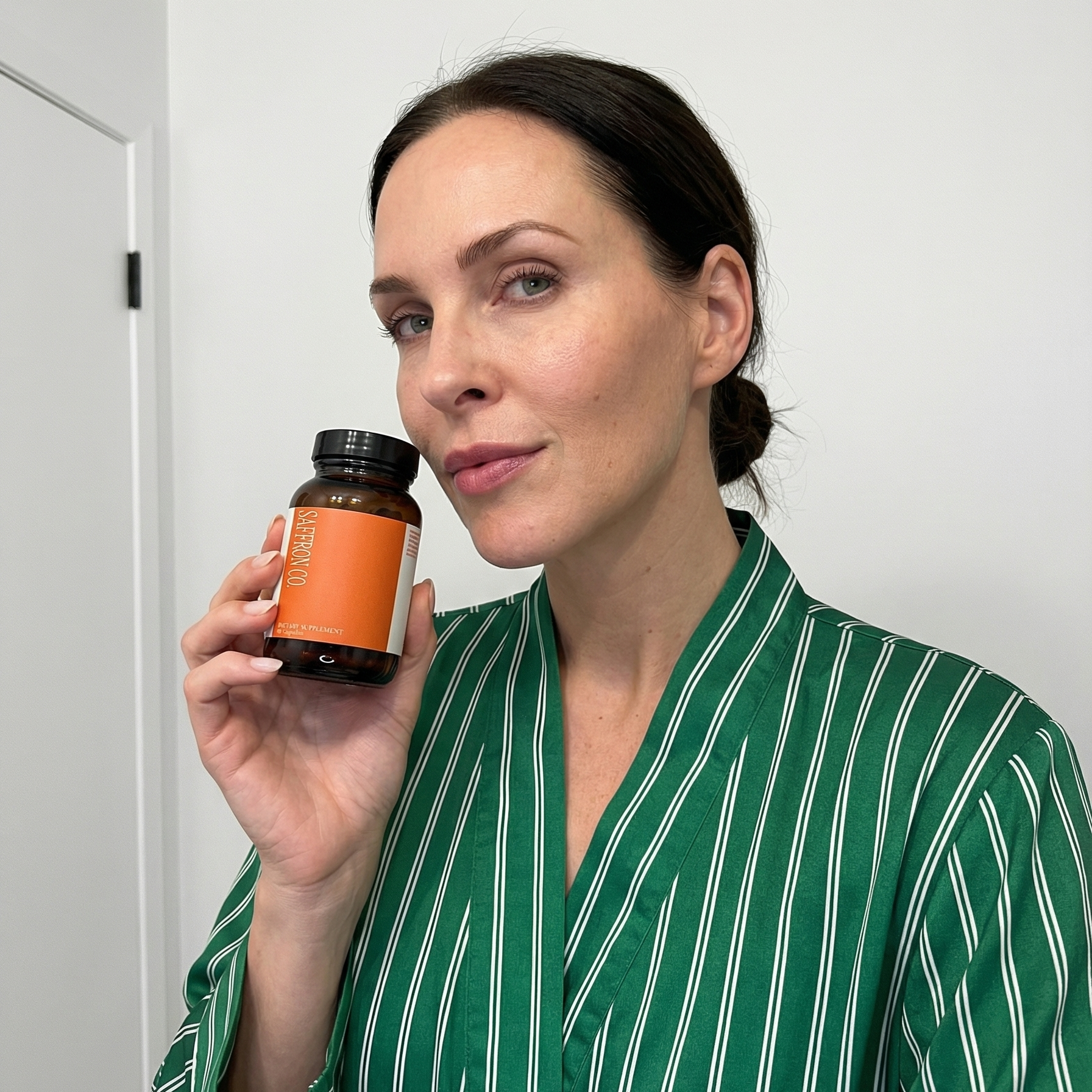
Saffron Dosage: How Much to Take, Safety, Timing & What the Research Uses
What Is the Right Saffron Dosage for Most Adults?
For most adults, the saffron dosage used most often in clinical research for mood support is 28 to 30 mg per day of standardized saffron extract.
Having said that, the right dose depends on the form of saffron, how the extract is standardized, what you are hoping to support, and how you personally respond. A label that simply says "saffron" does not tell you enough on its own.
It also helps to separate two very different things: culinary saffron threads and standardized saffron extract supplements. The saffron you cook with may be high quality as a spice, but it is not the same as a clinically standardized supplement designed for consistent daily dosing.
And one important boundary up front: saffron is a dietary supplement. It may help support mood balance and emotional well-being for some people, particularly with consistent use, but it is not a treatment for depression, anxiety disorders, or other diagnosable conditions.
The Clinically Studied Saffron Dose Per Day
If you want the research-aligned starting point, it is this: 30 mg per day.
That is the saffron dose per day used in many human trials looking at mood-related support, with most studies running for 6 to 8 weeks. Some use 28 mg, some 30 mg, but they sit in the same practical range.
Just be careful with the wording. This dose refers to a standardized saffron extract, not a rough teaspoon-equivalent of cooking saffron.
Why Standardization Matters More Than a Big Number on the Label
A saffron supplement is only as meaningful as its extract quality. What matters most is not a flashy milligram count. It is whether the product tells you what is actually in that extract.
Two markers often used to judge saffron quality are crocin and safranal. These are among the compounds most associated with saffron's studied effects. A supplement that clearly states its standardization can tell you much more than one that just says "saffron blend" or "premium saffron powder."
In practice, a lower standardized dose may be more useful than a higher unstandardized dose. That is why chasing a bigger number on the front of the bottle often leads people in the wrong direction.
How Saffron Dosage Changes by Goal: Mood, Stress, Libido, Focus, and Weight Support
Saffron gets discussed for a wide range of goals online. Some of that interest is reasonable. Some of it runs ahead of the research.
The evidence is strongest for mood support. It is more limited for appetite, libido, focus, and women's hormone-related symptoms. That does not mean those areas are irrelevant. It means they deserve more careful expectations.
Saffron Dosage for Mood Support and Emotional Well-Being
This is the most evidence-backed use case.
Most studies looking at saffron for mood support use 28 to 30 mg daily of saffron extract. The pattern across the literature is fairly consistent: daily use, clinically standardized extract, and a study window of several weeks rather than several days.
That timeline matters. Saffron is not usually something people feel dramatically on day one. With consistent use, many people experience more subtle shifts in emotional steadiness, motivation, or overall mood over 4 to 8 weeks.
Saffron Dosage for Anxiety-Like Stress Symptoms
People often search for "saffron dosage for anxiety," but this needs careful framing.
Some studies looking at stress-related mood symptoms use similar 28 to 30 mg extract ranges, and saffron may help support emotional balance and stress resilience for some people. But that is not the same as treating an anxiety disorder.
The more accurate takeaway is that saffron may help support the body's stress response and emotional well-being in people dealing with low-grade stress or tension. If someone is dealing with persistent or clinically significant anxiety, supplement decisions should sit alongside professional care, not replace it.
Saffron Dosage for Weight Loss and Appetite Support
Searches for "saffron dosage for weight loss" are common, but this is one of the areas where online claims often outrun the evidence.
There are small studies looking at saffron and appetite, snacking behavior, and satiety, often using similar extract ranges. The results are interesting, but they tend to be modest, not dramatic. Saffron is not a serious fat-loss shortcut, and any supplement marketed that way deserves skepticism.
If appetite support is part of your goal, saffron may be worth exploring as one piece of a broader routine. It should not be framed as a primary weight-loss tool.
What About Libido, Focus, PMS, and Perimenopause Support?
These are reasonable areas of interest, especially for women in midlife, but the research is smaller.
Some studies have explored saffron for libido support, aspects of cognitive performance, and women's mood-related symptoms around the menstrual cycle or perimenopause. The dosage used is often still in the same general extract range.
The honest way to think about these is as secondary use cases. They are plausible and worth discussing, but the evidence is not as deep as it is for general mood support.
How to Choose a Saffron Supplement That Matches the Research
Before you buy any saffron supplement, it helps to know what the research actually used. Dose only matters if the product resembles the formulas that were studied.
If you want a deeper ingredient primer first, Saffron Co's guide to saffron extract breaks down what to look for in more detail.
What to Look for on the Label
A good saffron supplement label should tell you:
- Dose per serving
- That it is an extract, not just powdered saffron
- Standardization markers, such as crocin and safranal
- Source quality
- Third-party testing
- Whether it is a single-ingredient formula or part of a broader stack
Labels like "saffron powder blend" are less helpful because they leave too much unanswered. You cannot tell whether the product lines up with clinical use, or whether it is mostly marketing language.
Single-Ingredient vs Multi-Ingredient Formulas
A pure saffron supplement can make sense if you want the simplest possible approach and prefer to evaluate one ingredient at a time.
A multi-ingredient formula can make more sense if your picture is broader. For example, if you are dealing with flat mood, stress, and brain fog together, a stack that combines saffron with complementary ingredients may fit better than saffron alone. For a closer look at saffron supplement ingredients and what makes a formula worth considering, Saffron Co's ingredient guide covers that ground in detail.
There is no single correct format. The better question is whether you want one ingredient or a more complete daily ritual.
Where Saffron Co Fits If You Want a Clinically Aligned Daily Dose
If you want a formula built around the clinically studied saffron range, Saffron Co Mood and Vitality Capsules fit that use case well.
The formula provides 30 mg per day of Spanish saffron extract, standardized to ≥3.0% trans-crocin and ~1.2% safranal, then pairs it with four supporting ingredients chosen for a specific reason: Rhodiola rosea for stress adaptation, magnesium glycinate for nervous-system support, active vitamin B6 (P5P) for neurotransmitter activation, and ProbioMood NU-10 to support the gut-brain axis.
That makes it a strong fit for women who want support for mood balance, stress resilience, focus, and libido in one daily formula, rather than saffron alone.
As a newer brand, Saffron Co has less long-term independent market history than some established competitors. The brand answers that honestly with a 90-day money-back guarantee, which matters if you prefer to test response without taking all the risk yourself. To read what our customers say about their experience, Saffron Co's reviews page shares real feedback from people using the formula.
How to Take Saffron for Best Results: Timing, Consistency, and Common Mistakes
The good news is that saffron dosing does not usually require obsessive timing. The bigger factor is consistency.
Morning or Night: When Should You Take Saffron?
Many people take saffron in the morning. That often makes practical sense, especially if the formula includes ingredients like Rhodiola, which some people find better earlier in the day.
That said, timing can depend on the product and your personal response. Some people do well taking both capsules at once. Others prefer splitting the dose.
Do You Need to Take Saffron With Food?
Many people tolerate saffron well with or without food.
If you tend to have a sensitive stomach, taking it with food may feel gentler. There is no need to overcomplicate this. The best approach is the one you can stick to consistently.
How Long Does Saffron Take to Work?
This is where expectations matter.
Some people notice subtle changes earlier, but the research window is usually 4 to 8 weeks. Saffron is not an instant-feel supplement like caffeine or L-theanine. If you stop after a few days, you are not really testing what the studies studied.
Common Dosage Mistakes to Avoid
A few mistakes show up over and over:
- Taking it inconsistently
- Assuming more is better
- Confusing culinary saffron with standardized extract
- Buying unstandardized products
- Giving up after three or four days
Those mistakes are a big reason people conclude a supplement "does nothing" when the real issue is that the product or routine never matched the research.
Safety, Side Effects, and the Limits of Saffron Dosage Advice
Saffron is generally well tolerated in studied ranges, but dosage advice always has limits. Pregnancy, medications, and individual sensitivity can change the picture.
For a fuller breakdown, see Saffron Co's guide to saffron side effects.
If you are taking prescription medication for mood, sleep, or any other condition, talk with your healthcare provider before starting a new supplement. The same applies if you are pregnant or nursing. This article is for informational purposes and is not medical advice.
Possible Side Effects and Who Should Be More Careful
Possible side effects are usually mild when they happen, but some people may notice digestive discomfort, headache, or light dizziness.
People who should be more careful include those who are:
- Pregnant or nursing
- Taking prescription medications
- Managing a diagnosed mental-health or hormone-related condition with medical care
Can You Take Saffron Every Day?
Daily use is the pattern used in most clinical research, so yes, that is the usual framework.
Still, long-term use should be thoughtful. The evidence on saffron is encouraging, but much of it is still made up of short to medium-length studies, often around 6 to 12 weeks. That is useful, but it is not the same thing as decades of long-term outcome data. For a deeper look at saffron clinical studies and what the research actually demonstrates, Saffron Co's clinical studies guide covers the evidence in detail.
What Saffron Cannot Do
This is where dosage advice needs a clear ceiling.
Saffron dosage guidance cannot substitute for medical advice, diagnosis, therapy, or prescribed care for depression, anxiety disorders, ADHD, insomnia, or hormone-related conditions.
Saffron may help support mood balance, stress response, and emotional well-being. It is not a cure, and it does not work overnight.
A Simple Bottom Line on Saffron Dosage
If you are choosing a high-quality standardized saffron supplement, 28 to 30 mg per day is the research-aligned place to start for most adults, unless a clinician advises otherwise.
Buy a saffron formula if that dose range, extract transparency, and your goals line up. If you want a more complete stack for mood, stress, focus, and libido support, a formula like Saffron Co may make more sense than saffron alone. If you prefer the simplest possible approach, a single-ingredient standardized extract may be the better fit. There is no single best answer, only the best fit for what you are actually trying to support.
FAQ
What is the recommended saffron dosage per day?
For most adults, the most commonly studied saffron dosage is 28 to 30 mg per day of standardized extract.
Is 30 mg the right saffron dose for most adults?
Often, yes. 30 mg per day is the dose used in many human studies for mood-related support. The main caveat is that the product should use a standardized extract, not just generic saffron powder.
How long does saffron take to work?
Most research measures outcomes over 4 to 8 weeks. Some people notice subtle effects earlier, but saffron is usually not an immediate-feel supplement.
Can you take saffron every day?
Yes. Daily use is the pattern used in most clinical studies. Still, it makes sense to be thoughtful about long-term use and to check with a healthcare provider if you take medication or have a relevant medical condition.
What is the best saffron dosage for anxiety-like stress symptoms?
Studies looking at stress-related mood symptoms often use 28 to 30 mg per day of standardized saffron extract. Saffron may help support stress resilience and emotional balance, but it is not a treatment for anxiety disorders.
What is the best saffron dosage for weight loss or appetite support?
Appetite-related studies often use similar extract ranges, but the evidence is more limited and the effects tend to be modest. Be cautious with aggressive weight-loss claims attached to saffron supplements.
Should I take a saffron supplement in the morning or at night?
Many people take saffron in the morning, especially if the formula includes more energizing support ingredients like Rhodiola. But morning versus night matters less than consistent daily use.
Is culinary saffron the same as a standardized saffron supplement?
No. Culinary saffron threads and standardized saffron extract are not the same thing. Clinical dosing refers to a standardized supplement extract, not a rough amount of cooking saffron.
Read more
Learn the most common saffron side effects, including dosage concerns, medication interactions, safety during pregnancy, daily use risks, and what the research says about saffron supplemen...

Discover how saffron works in the brain, including serotonin support, neuroplasticity, stress response, and mood-related benefits backed by human research.