

Saffron is one of the few supplements with real clinical research behind premenstrual mood. Here is what the studies actually show, how it may help and what it will not, the dose that matters, and when PMS needs a clinician instead of a supplement.
What PMS really feels like, and why saffron comes up so often
For many women, PMS is not just a few cravings and a slightly worse mood. It can feel like becoming a less resilient version of yourself for several days each month. Irritability rises faster. Small things feel bigger. Motivation drops. You may feel more tearful, more easily overwhelmed, more tired, or simply unlike yourself before your period starts.
That experience is common, even if it shows up differently from person to person. PMS can include emotional symptoms like low mood, mood swings, and sensitivity, along with physical symptoms such as bloating, breast tenderness, fatigue, and appetite changes.
Saffron comes up often in this conversation because it has been clinically studied for mood support. That does not make it a cure for premenstrual symptoms, and it does not mean every woman will respond the same way. It does mean there is a real evidence base behind the idea that saffron may help support emotional well-being during cyclical hormonal shifts.
If you want the broader picture of how saffron fits women's health, start with the overview of saffron for women.
The short version: saffron's most credible role in PMS is mood, not physical symptoms. The research is promising but still small, so treat it as a reasonable daily option to try over a couple of cycles, not a guaranteed fix. And it is not a treatment for PMDD.
See what saffron may help with →
PMS vs PMDD: why the distinction matters
PMS is broad and common. PMDD, or premenstrual dysphoric disorder, is a diagnosable condition marked by much more severe cyclical mood symptoms and functional impairment. That distinction matters.
A supplement like saffron may help support normal mood balance in women dealing with milder premenstrual mood changes. It is not a treatment for PMDD, and it should not be framed that way. If your symptoms feel severe, disrupt work or relationships, or leave you unable to function normally each month, that is a reason to involve a clinician rather than trying to self-manage with supplements alone. If PMDD is your concern specifically, saffron for PMDD covers where saffron does and does not fit.
Why readers search for natural support in the first place
Most women looking into saffron for PMS are not looking for hype. They are usually trying to answer a practical question: is there something evidence-aware that might help me feel more like myself before my period?
That skepticism is fair. Some readers are wary of supplements because many are underdosed or vague. Others are cautious about conventional options because they do not want to jump straight to medication for symptoms that may be cyclical, moderate, or still evolving. The useful approach is not supplement-first or medication-first. It is evidence first.
Does saffron help PMS? What the research actually shows
The short version is yes, there is promising research on saffron for PMS, especially around mood-related symptoms. But the evidence is still limited by small sample sizes and short study duration, so it is best read as encouraging rather than definitive. The table below maps where saffron is most and least relevant.
| PMS concern | Saffron evidence | What that means in practice |
|---|---|---|
| Mood & irritability | Strongest | The best-studied use. May help support mood balance and steadiness in the luteal phase. |
| Stress reactivity & emotional flatness | Moderate | May support a steadier response when you feel frayed, wound up, or flat before a period. |
| Sleep around your cycle | Indirect | May help indirectly when poor sleep follows low mood or stress. Not a sleep aid on its own. |
| Libido dips | Emerging | May help when low desire is tied to mood or stress. Not a stand-alone fix. |
| Physical symptoms (bloating, breast tenderness) | Limited | Not where the evidence is. Saffron is a mood-first ingredient, not a physical-symptom fix. |
| Severe pain, heavy bleeding, PMDD | Not a fit | Needs medical assessment and care, not a supplement. |
Saffron has also been studied more broadly for mood support, usually at around 28 to 30 mg per day. That wider body of research helps explain why it is relevant during the premenstrual phase, when emotional symptoms often become more noticeable.
In studies, researchers have generally looked at symptom severity, mood symptoms, irritability, emotional discomfort, and overall premenstrual burden. That is important context. The research is not showing dramatic overnight changes. It is measuring whether daily supplementation meaningfully shifts the monthly pattern over time.
What a PMS-specific trial found
One randomized, double-blind, placebo-controlled trial studied Crocus sativus in women with PMS over two menstrual cycles. The saffron group showed greater improvement in symptom scores and reported mood-related benefits compared with placebo.
That is meaningful. It suggests saffron may help support women whose PMS shows up strongly as irritability, emotional volatility, or low mood before a period. At the same time, this was still a relatively small and short trial. It gives a reason to take saffron seriously, not a reason to overstate certainty.
What systematic reviews add, and where they still fall short
Broader reviews of saffron research, including work looking at menstrual and mood-related symptoms, generally point in a positive direction. They suggest saffron may offer support for PMS symptoms, particularly emotional ones.
The limitation is that the evidence base is still developing. Many saffron studies are short, often 6 to 8 weeks, and many involve modest participant numbers. That does not erase the findings, but it should shape how confident we sound about them.
Why mood support is the most credible angle
Mood support is the most evidence-aligned reason to consider saffron for PMS. That includes irritability, stress reactivity, low mood, emotional sensitivity, and that flat or frayed feeling some women notice in the luteal phase.
That is a more credible framing than suggesting saffron solves every PMS symptom across the board. If your main issue is cyclical emotional turbulence, the research is more relevant. If your main issue is severe pain, very heavy bleeding, or extreme cycle disruption, saffron is probably not the place to start.
How saffron may help during PMS
Saffron appears to interact with serotonin, dopamine, and stress-related pathways. It has also been studied for antioxidant and neuroprotective effects, and some research suggests it may support BDNF, a factor involved in brain health and plasticity, though that evidence is mainly preclinical.
In plain language, that matters because the premenstrual phase can be a time when mood feels less stable and stress feels harder to absorb. If PMS makes you more irritable, emotionally reactive, unmotivated, or less able to bounce back from normal stress, saffron's mood-support angle is where the logic is strongest.
Some women also look into saffron for adjacent concerns such as lower libido, feeling emotionally flat, or disrupted sleep around their cycle. Those are reasonable questions, but the strongest support remains around mood balance and emotional well-being. The further you move from that core use case, the more careful the interpretation should be.
Saffron, serotonin, and cyclical mood changes
PMS mood symptoms are often discussed through the lens of hormone-related neurotransmitter shifts, especially serotonin. Hormonal changes across the menstrual cycle may influence how some women feel emotionally in the luteal phase, even if the exact picture is different for each person.
Saffron is most often studied in this serotonin-and-mood context. That is one reason it keeps appearing in conversations around PMS. It may help support the neurochemical side of cyclical mood changes, particularly with consistent use.
Could saffron help stress, sleep, or feeling flat before your period?
Possibly, but with limits. If PMS tends to make you feel more wound up, less resilient, or emotionally flat, saffron may help support a steadier mood response. Some women may also notice indirect benefits in sleep or libido when mood and stress are better supported, but that is not the same as saffron being a treatment for insomnia, anxiety, or hormonal imbalance.
If your symptoms are changing with age, it may be worth zooming out. What looks like worsening PMS can sometimes overlap with a bigger hormonal transition. The detail on saffron for menopause can help put that in context, and for women also noticing a shift in desire, saffron for libido may be relevant too.
When PMS may be part of a bigger hormonal picture
If your cycle symptoms have become more unpredictable in your late 30s or 40s, PMS may not be the full story. Perimenopause often changes mood, sleep, libido, and stress tolerance in ways that can look like "my PMS suddenly got worse."
That does not mean saffron cannot still be useful. It means the broader hormonal context matters.
How to take saffron for PMS, what dose matters, and how long to give it
If you are searching for how to take saffron for PMS, the main thing to know is that dose and standardization matter more than branding language.
The clinically studied saffron dose is typically 28 to 30 mg per day. Research generally uses consistent daily intake over several weeks, not occasional use only during the days symptoms appear. If you want to assess whether it helps, the evidence-based approach is daily use rather than taking it sporadically.
Look for a saffron supplement with a clearly stated dose, standardized extract, and transparent crocin and safranal markers if available. Proprietary blends that do not tell you how much saffron you are actually getting are hard to evaluate and easy to overpay for.
How long does saffron take to work for PMS?
Set your expectations in weeks, not days. Some women may notice shifts earlier, but most clinical effects with saffron are measured over 4 to 8 weeks of consistent use. That means one difficult cycle is not enough to judge it fairly. If you are trying saffron for PMS support, think in terms of at least one to two full cycles.
What to look for in the best saffron supplement for PMS support
The best saffron supplement for PMS support is usually not the one with the loudest marketing. It is the one that checks the practical boxes:
- around 28 to 30 mg of saffron per day
- standardized extract
- clear labeling
- third-party testing
- no vague proprietary blend hiding the dose
The label checklist, in one line: a stated daily dose near 28 to 30 mg, a standardized extract with visible crocin and safranal markers, third-party testing, and no proprietary blend hiding the saffron amount.
When a multi-ingredient formula may make more sense than saffron alone
For women whose PMS shows up mostly as mood changes, emotional flatness, stress sensitivity, or lower libido around the cycle, a multi-ingredient formula can be a reasonable fit.
Saffron Co Mood and Vitality Capsules use 30 mg per day of Spanish saffron extract standardized to at least 3.0% trans-crocin and about 1.2% safranal, which aligns with the clinically studied range. The formula also includes Rhodiola rosea for stress adaptation, magnesium glycinate for nervous-system support, vitamin B6 in its active P5P form for neurotransmitter activation, and a probiotic to support the gut-brain axis. You can read more about that formulation logic in why this formula.
As a newer brand, Saffron Co has less long-term independent market history than some established competitors. The 90-day money-back guarantee is the practical answer to that. Buy it if you want a complete saffron-based formula rather than saffron alone, and your PMS concerns lean heavily toward mood, stress resilience, and feeling like yourself again. If you prefer a simple single-ingredient saffron product, a pure saffron formula may be a better fit.
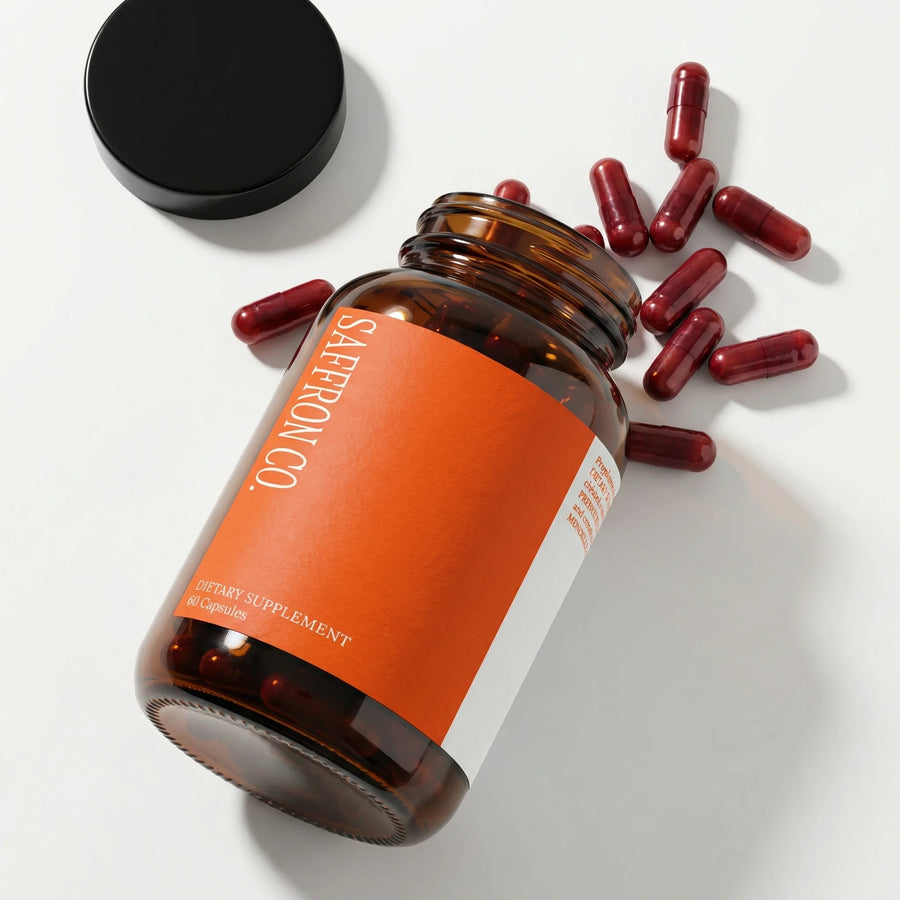
For the days each month you feel unlike yourself.
Saffron Co. pairs the studied 30 mg daily saffron dose with Rhodiola for stress adaptation, magnesium glycinate for nervous-system support, ProbioMood® NU-10 for the gut-brain axis, and active vitamin B6 (P5P), taken daily across the cycle rather than only on the hard days.
Safety, side effects, and what saffron cannot do
Saffron is generally well tolerated in studied amounts, but natural does not mean risk-free. Individual response varies. Some people may notice mild side effects such as digestive upset, headache, or dizziness, while many notice nothing at all.
The ceiling matters here. Saffron may help support mood-related PMS symptoms for some women. It is not a treatment for PMDD, depression, anxiety disorders, endometriosis, heavy menstrual bleeding, or other menstrual conditions that need medical care.
Does saffron cause heavy periods?
This is a real search concern, and the honest answer is that evidence does not clearly show saffron causes heavy periods at typical supplemental doses.
If you experience unusually heavy bleeding, new bleeding changes, or periods that are suddenly much more disruptive than usual, that deserves medical evaluation rather than assumption. Cycle changes can have many causes, and it is better not to guess.
Medication interactions and when to talk to your clinician
If you take antidepressants, other mood medications, hormone therapy, or any prescription medication, talk with a qualified clinician before starting saffron. The same applies if you are pregnant, nursing, or trying to conceive.
This article is for informational purposes only and is not medical advice. Saffron may be well tolerated for many people, but adding any mood-related supplement into a more complex health picture should be done thoughtfully.
When to look beyond supplements
When PMS needs more than a supplement: if your symptoms are severe every month, interfere with work or relationships, come with intense hopelessness, or suggest PMDD, it is time to look beyond supplements. The same goes for very painful periods, extremely heavy bleeding, or symptoms getting worse instead of staying predictable. Supplements can be supportive; they are not the right tool for every level of problem.
FAQ: saffron for PMS
Does saffron help PMS mood swings?
It may help support PMS mood swings, especially when those symptoms show up as irritability, low mood, emotional sensitivity, or stress reactivity. The research is promising, but still limited, so the best interpretation is that saffron may help some women with consistent use rather than producing dramatic results for everyone.
How long does saffron take to work for PMS?
Most saffron research measures effects over 4 to 8 weeks of daily use. Some women may notice changes sooner, but it is more realistic to assess it over one to two cycles rather than a few days.
How do you take saffron for PMDD or PMS?
For PMS, studies typically use about 28 to 30 mg of saffron per day, taken consistently. For PMDD, self-treatment with supplements is not the right starting point. PMDD is a diagnosable condition and warrants medical evaluation. If you are considering saffron and have severe cyclical symptoms, talk with a clinician first.
Does saffron cause heavy periods?
There is no clear evidence that saffron causes heavy periods at typical supplement doses. If you notice unusually heavy bleeding or a major change in your cycle, get it checked by a healthcare professional rather than assuming saffron is the cause.
What is the best saffron supplement for PMS support?
Look for a supplement that provides a clinically relevant saffron dose, usually around 28 to 30 mg per day, with standardized extract, transparent labeling, and third-party testing. If your PMS includes mood changes plus stress sensitivity or nervous-system strain, a multi-ingredient formula like Saffron Co may make sense. If you want simplicity, a single-ingredient saffron supplement may be enough.
Can you take saffron with antidepressants or hormone therapy?
Do not assume yes or no on your own. If you take antidepressants, hormone therapy, or other prescription medication, check with your clinician before starting saffron. That is the safest approach, especially when mood symptoms and hormones are already part of the picture.
This article is for informational purposes only and is not medical advice. Saffron supplements do not diagnose, treat, or cure PMS, PMDD, depression, anxiety, or any menstrual or mood condition, and they are not a substitute for medical care where that is needed. If you have severe or worsening cyclical symptoms, unusual bleeding, take prescription medication, or are pregnant, nursing, or trying to conceive, talk with a qualified healthcare provider before starting a new supplement. These statements have not been evaluated by the Food and Drug Administration. This product is not intended to diagnose, treat, cure, or prevent any disease.