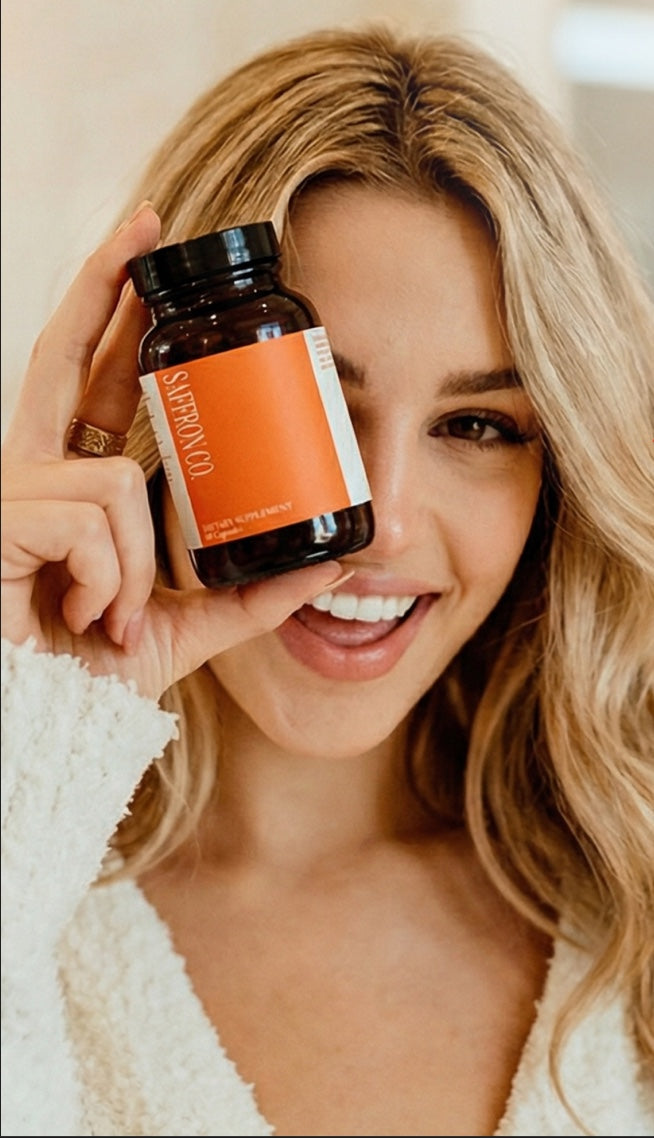

Saffron is one of the better-studied botanicals for premenstrual mood, and there is now a direct PMDD trial behind the interest. Here is what that research honestly shows, the dose, and the firm line underneath all of it: saffron may support premenstrual mood, but it is not a treatment for PMDD.
PMDD can make the premenstrual phase feel much bigger than ordinary PMS. For some women, the shift is not just irritability or bloating. It is a noticeable drop in emotional steadiness, patience, motivation, or the sense of feeling like yourself. That is why interest in saffron for PMDD has grown.
Read this first: PMDD is a diagnosable medical condition, and saffron is not a treatment for it. It may help support premenstrual mood for some people, but if your symptoms disrupt work, relationships, or safety, or include hopelessness, severe rage, or thoughts of self-harm, that is a clinician conversation, not a supplement one. This guide is informational and not medical advice.
There is a reason saffron keeps coming up. It is one of the better-studied botanicals for mood support, and a small but relevant body of research suggests it may help support some premenstrual symptoms in certain women. Still, the ceiling matters. Saffron is not a treatment for diagnosed PMDD, and it should not be framed as a replacement for medical care, therapy, or prescribed medication when those are needed.
If you want the short version: the evidence is encouraging but limited. Saffron may help support mood balance, emotional well-being, and stress resilience around the menstrual cycle for some people. It has not been shown to resolve the full PMDD picture. If you are comparing clinically dosed saffron formulas, it helps to understand why formulation matters before weighing options.
See the honest evidence read →
What PMDD is, and why people look at saffron for it
PMDD stands for premenstrual dysphoric disorder. It is a diagnosable premenstrual disorder marked by significant mood-related and physical symptoms that reliably show up in the luteal phase, usually the week or two before a period, and improve once menstruation starts. The core issue is not just discomfort. It is the degree to which symptoms disrupt daily life, relationships, work, or basic functioning.
People look at saffron for PMDD because the symptom pattern can feel deeply cyclical and emotionally draining. Many women notice they are mostly fine for part of the month, then feel unlike themselves in the days before their period. That leads to understandable interest in support tools that may help steady mood, reduce stress reactivity, or make the emotional drop feel less severe.
PMS vs PMDD: the difference matters
PMS is common and can still be very real and frustrating. PMDD is different in severity. With PMS, symptoms may be uncomfortable but manageable. With PMDD, emotional symptoms can become intense enough to affect work, home life, relationships, and the ability to function normally.
That distinction changes what self-care can realistically do. For milder premenstrual mood shifts, a supplement trial may be a reasonable part of the picture, and saffron for PMS covers that lane. For diagnosed or strongly suspected PMDD, supplements belong in a broader support plan, not in place of one.
Why saffron keeps coming up in PMDD conversations
Saffron keeps surfacing because it has been clinically studied for mood support at a fairly consistent dose, usually 28 to 30 mg per day, and because there is now direct premenstrual research, including a randomized controlled trial in women with PMDD. That does not make saffron a PMDD treatment. It does explain why the interest exists.
Does saffron help PMDD? What the evidence actually shows
The most honest answer: saffron may help support some premenstrual symptoms, especially mood-related ones, but the research is still limited and not strong enough to say it treats PMDD. Here is the same picture as a quick reference.
| What people ask about | The evidence-based read | Detail |
|---|---|---|
| Premenstrual mood & irritability | May support | Backed by a direct PMDD randomized trial and a PMS meta-analysis. |
| Stress reactivity & emotional steadiness | May support | Consistent with saffron's broader mood-support research at 28-30 mg/day. |
| PMDD as a diagnosable disorder | Not a treatment | Not shown to resolve the condition itself; evidence is early and limited. |
| Replacing SSRIs or prescribed care | No | Not a substitute for clinician-guided treatment. |
| Severe or crisis symptoms | See a clinician | Rage, hopelessness, or thoughts of self-harm need urgent care, not a supplement. |
The PMDD trial most people are looking for
The study most readers are searching for is a 2020 randomized controlled trial that enrolled 120 women diagnosed with PMDD and compared saffron (30 mg per day) with a prescription medication and with placebo over two menstrual cycles. On the daily record of symptom severity, the saffron group improved significantly more than placebo.
That is a genuinely encouraging result for a botanical. The honest boundaries matter just as much. It was a single trial run over two cycles, the benefit showed up on one symptom scale but not every measure, and the researchers were testing saffron as a candidate agent, not establishing it as a standard treatment. The right takeaway is not that saffron treats PMDD. It is that there is real, direct evidence worth paying attention to for premenstrual mood support.
What PMS studies add to the picture
A 2026 systematic review and meta-analysis of saffron for premenstrual syndrome and dysmenorrhea adds context. Pooling the randomized trials, it found saffron had a significant positive effect on PMS symptoms. That helps explain why saffron is being explored in the PMDD conversation, but PMS and PMDD are not interchangeable, and PMS data cannot prove saffron treats PMDD.
Why saffron may influence mood before a period
Mechanistically, saffron compounds such as crocin and safranal are thought to influence serotonin and dopamine signaling, along with antioxidant and stress-response effects. That matters because premenstrual mood changes are often tied to how the brain responds to hormonal fluctuation. A botanical that supports mood balance may help some women feel steadier through that window, even though PMDD itself involves more than one pathway.
What saffron may help with, and what it cannot do
When people search for saffron for PMDD, they are usually not asking about the diagnosis in the abstract. They are asking whether it might help with the part that feels hardest to live through.
Symptoms saffron may help support
Based on the available evidence, saffron may help support mood balance, emotional well-being, irritability and emotional volatility, stress reactivity, tension, and focus when brain fog or overwhelm are part of the picture. That does not mean every symptom improves, or that improvement is dramatic. The realistic frame is gentler: with consistent use, some people notice the emotional dip feels less sharp, their stress response feels less reactive, or they feel a bit more like themselves in the days before a period.
What saffron cannot do for PMDD
Saffron cannot honestly be described as a treatment for PMDD. It has not been shown to treat PMDD as a clinical disorder, replace SSRIs, correct underlying hormonal sensitivity, override severe symptoms that disrupt daily life, or make urgent, safety-related symptoms manageable without professional care. That limitation is not a weakness in the article. It is the line between supportive wellness guidance and overclaiming.
When symptom severity points beyond supplements: if your symptoms are intense, worsening, or clearly cyclical in a way that affects work, relationships, or safety, talk with a clinician. The same applies if you dread part of every month because you feel emotionally unrecognizable, or if you experience hopelessness, severe rage, panic, or thoughts of harming yourself. Supplements are not the right tool for crisis-level symptoms or for making sense of a possible PMDD diagnosis.
How to take saffron for premenstrual mood: dose, timing, and label
There is no universally established PMDD-specific saffron protocol. Most guidance comes from the broader mood-support literature, where dose and timing are more consistent.
The dose range used in research
Most saffron studies use about 28 to 30 mg per day, and the PMDD trial used 30 mg per day. That is the clinically studied saffron dose to pay attention to. More is not necessarily better. Higher dosing does not clearly improve outcomes and may increase the chance of side effects.
How long saffron may take to work
Saffron is not an overnight supplement. In the clinical literature, noticeable effects are generally measured over 4 to 8 weeks of daily use. Some people report earlier shifts, others do not respond much at all. For cycle-related symptoms, it also makes sense to judge a supplement over at least two menstrual cycles rather than a few scattered days.
What makes a saffron supplement worth considering
The label checklist, in one line: a clearly stated saffron dose in the 28-30 mg range, standardization markers such as trans-crocin and safranal, third-party testing, transparent labeling, and formulation logic rather than vague promises. A clinically relevant supplement tells you what is in it, at what dose, and why.
When a broader formula may make sense
Some women are not only dealing with premenstrual mood shifts. They are also dealing with stress, brain fog, poor stress tolerance, or general nervous-system strain across the month. In those cases, a broader formula may make more sense than saffron alone.
Saffron Co is one example of that approach. It uses 30 mg of Spanish saffron standardized to at least 3.0% trans-crocin and about 1.2% safranal, then pairs it with Rhodiola rosea for stress adaptation, magnesium glycinate for nervous-system support, active-form vitamin B6 for neurotransmitter activation, and a probiotic to support the gut-brain axis. It is not positioned as a PMDD treatment. It is a fit for readers who want clinically dosed saffron plus wider mood, stress, and mental-clarity support. As a newer brand, it has less long-term independently published history than some established companies, which is what the 90-day money-back guarantee answers.
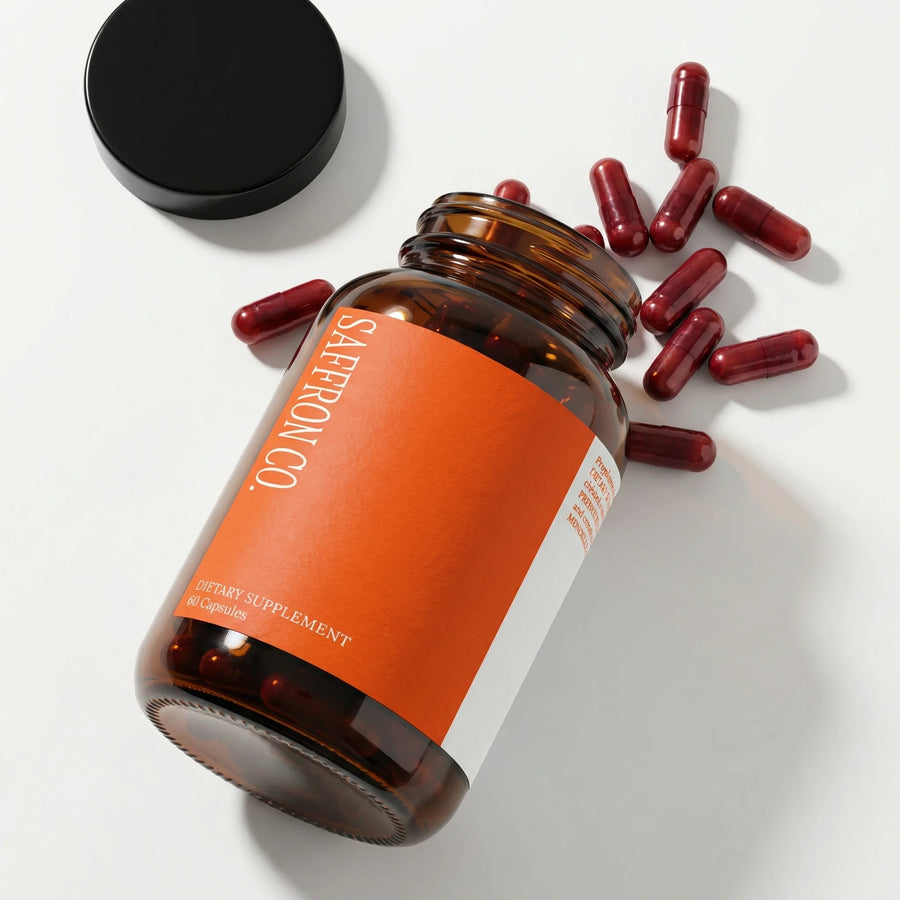
Clinically dosed saffron for premenstrual mood support.
The studied 30 mg daily saffron dose, with Rhodiola, magnesium glycinate, active vitamin B6 (P5P), and a probiotic, for mood, stress, and emotional steadiness across the cycle. Not a treatment for PMDD; a daily support tool alongside the right care.
Safety, side effects, and cycle questions
Saffron is generally well tolerated at typical supplemental doses, but natural does not mean risk-free. Safety questions matter, especially when the topic involves mood symptoms and the menstrual cycle.
Does saffron cause heavy periods?
There is not strong evidence that saffron causes heavy periods for most users. That said, any noticeable menstrual change should be taken seriously. If you start a new supplement and notice unusually heavy bleeding, unusual cycle changes, or symptoms that concern you, stop and speak with a clinician.
Side effects and medication considerations
In research, saffron is generally described as well tolerated at typical supplemental doses. Possible side effects can include digestive upset, headache, dizziness, or individual sensitivity, though not everyone experiences these. If you take antidepressants or other mood-related medications, get personalized guidance before adding saffron. If you are currently taking prescription medication for mood, anxiety, sleep, or any other condition, or you are pregnant or nursing, talk with your healthcare provider before introducing a new supplement.
Who should be cautious
Extra caution makes sense if you are pregnant or breastfeeding, under active treatment for a mood disorder, managing severe psychiatric symptoms, taking complex medication combinations, or unsure whether your symptoms are PMS, PMDD, or something else. In those cases, clinician input matters more than supplement experimentation.
Where saffron fits in a bigger PMDD support plan
The most useful way to think about saffron is as one possible support tool, not the whole strategy. PMDD often requires a wider plan that may include cycle tracking, sleep support, steady meals, stress reduction, therapy, and clinician-guided treatment. For some women, that plan may also include medication or hormonal support. These are different tools for different levels of severity.
What a realistic trial looks like
A grounded trial looks something like this: track symptoms across at least two cycles, take the supplement consistently rather than only during bad days, note patterns in mood, irritability, focus, and stress response, and pay attention to sleep, caffeine, alcohol, and stress load, since all of them shape what the luteal phase feels like. That structure makes it easier to tell whether saffron is helping or whether something else needs attention first.
How to decide whether saffron is a good fit
Consider a saffron supplement if your main goal is support for mood balance, stress resilience, and emotional steadiness around your cycle, especially if symptoms feel real but not unmanageable. A broader saffron formula may be worth considering if low mood overlaps with brain fog, stress overload, or nervous-system strain and you prefer a single daily stack. Look elsewhere first if you need diagnosis, medication guidance, urgent symptom care, or help with severe cyclical symptoms that interfere with safety or daily functioning. For the wider picture of how saffron is studied in women, see saffron for women.
FAQ: saffron for PMDD
Does saffron actually help PMDD?
It may help support some premenstrual symptoms, especially mood balance and emotional well-being, but the evidence is still limited. One randomized trial in women with PMDD is encouraging, and broader PMS and mood research adds support, yet saffron has not been shown to treat PMDD as a disorder or to replace prescribed care.
How much saffron should you take for premenstrual mood?
Most saffron research uses about 28 to 30 mg per day, and the PMDD trial used 30 mg per day. That is the most evidence-based range to look for. More is not necessarily better.
How long does saffron take to work for premenstrual symptoms?
A realistic window is about 4 to 8 weeks of daily use. Because premenstrual symptoms are cyclical, it is smart to assess results over at least two menstrual cycles rather than a few days.
Does saffron cause heavy periods?
There is not strong evidence that saffron causes heavy periods for most people. If you notice unusually heavy bleeding or significant cycle changes after starting it, stop and speak with a clinician.
Can you take saffron with antidepressants?
Do not assume yes. If you take antidepressants or other mood-related medication, talk with your healthcare provider before adding saffron. You need individualized guidance here, and this is not a decision to make on your own.
What is the best saffron supplement for premenstrual mood?
There is no single best answer; the right choice depends on what you are trying to support. Look for a clinically relevant dose around 30 mg, clear standardization, transparent labeling, and third-party testing. If you want saffron plus support for stress and the gut-brain axis, a broader formula like Saffron Co may be worth considering. If you prefer simplicity, a single-ingredient saffron product may be a better fit.
This article is for informational purposes and is not medical advice. PMDD is a diagnosable medical condition; saffron supplements do not diagnose, treat, cure, or prevent PMDD, PMS, depression, or any condition, and they are not a substitute for therapy, prescribed medication, or clinician-guided care. If your premenstrual symptoms are severe, worsening, or include hopelessness, rage, or thoughts of self-harm, seek professional care promptly. If you take prescription medication or hormone therapy, or are pregnant or nursing, talk with a qualified healthcare provider before starting a new supplement. These statements have not been evaluated by the Food and Drug Administration. This product is not intended to diagnose, treat, cure, or prevent any disease.